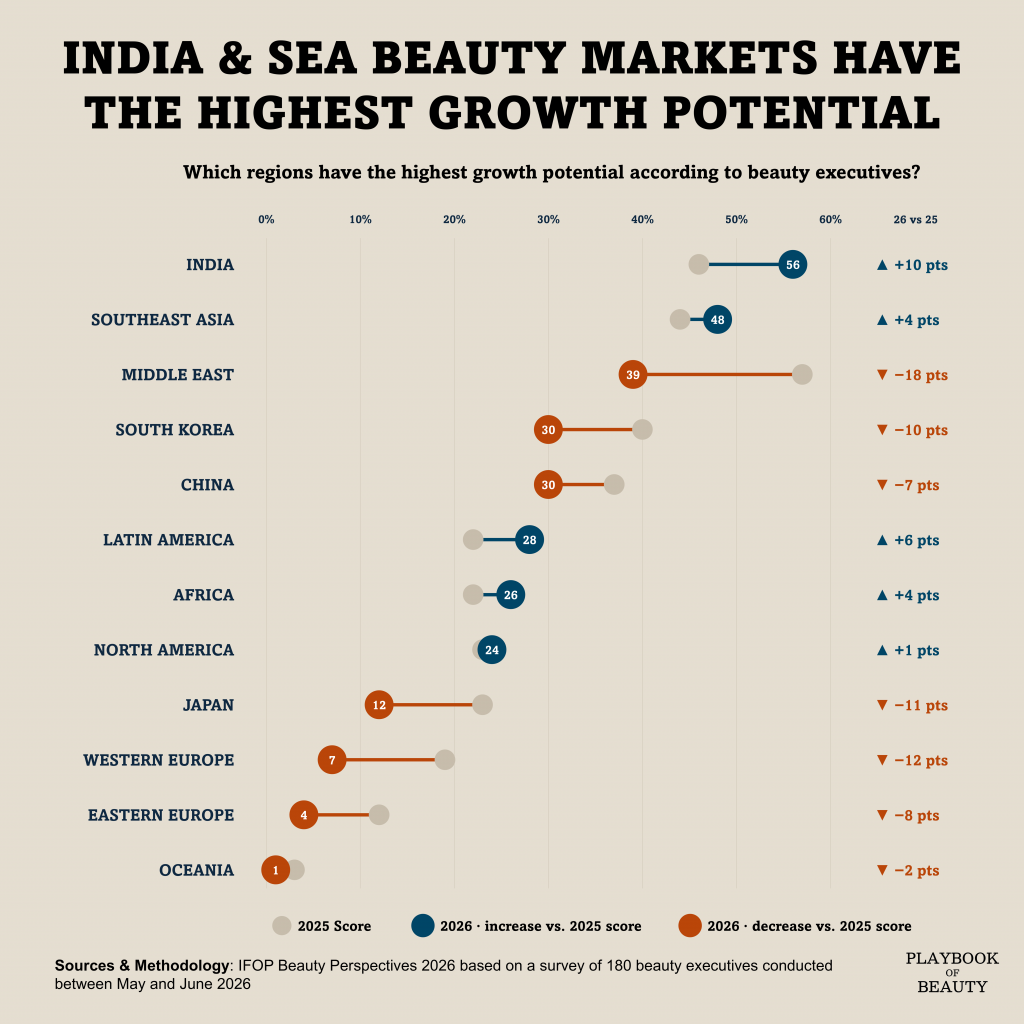
IFOP’s Beauty Perspectives 2026 survey, conducted among 180 industry professionals, showed that 56% of respondents identified India as the region with highest growth potential, up 10pts from 2025. Southeast Asia followed at 48%, up 4pts over 2025.
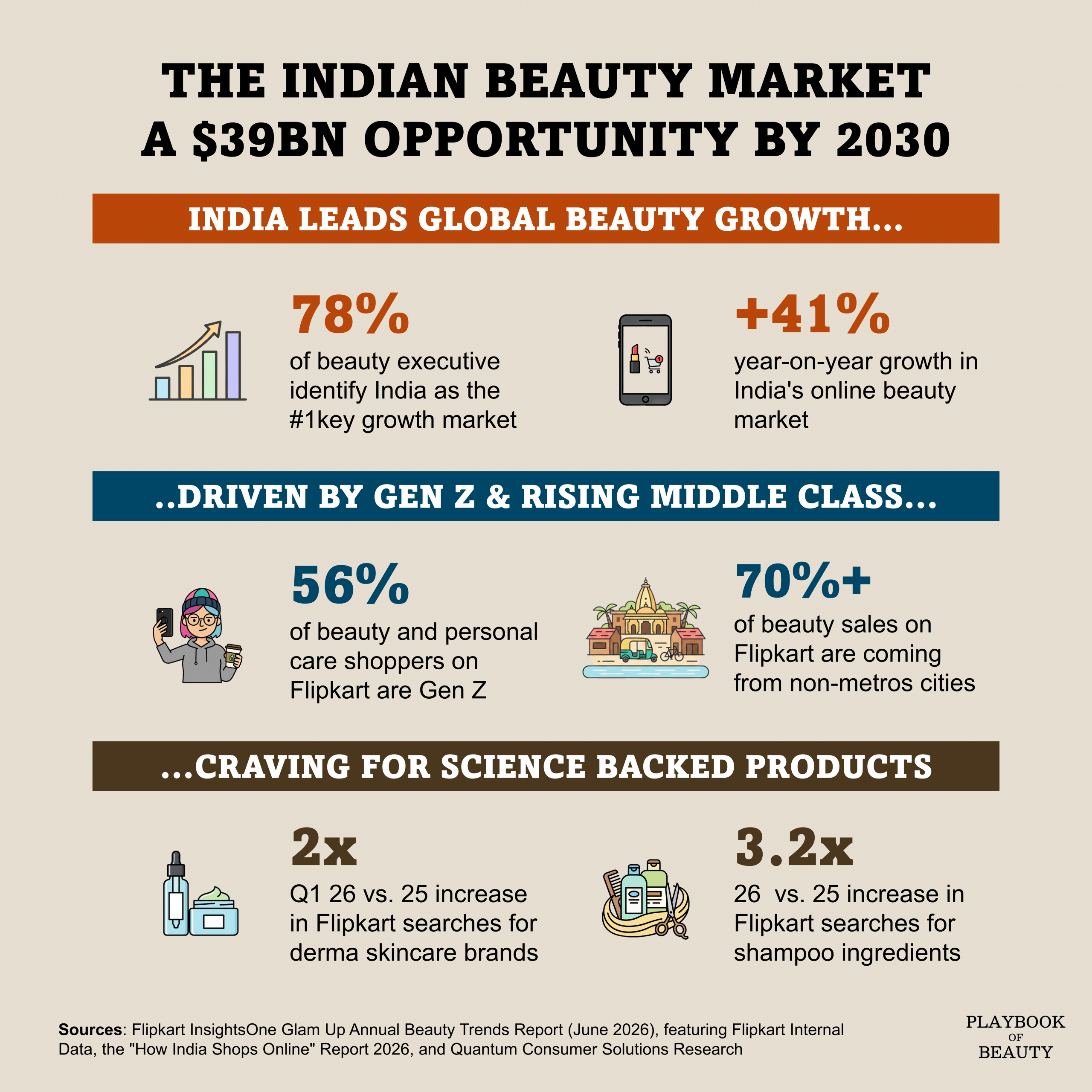
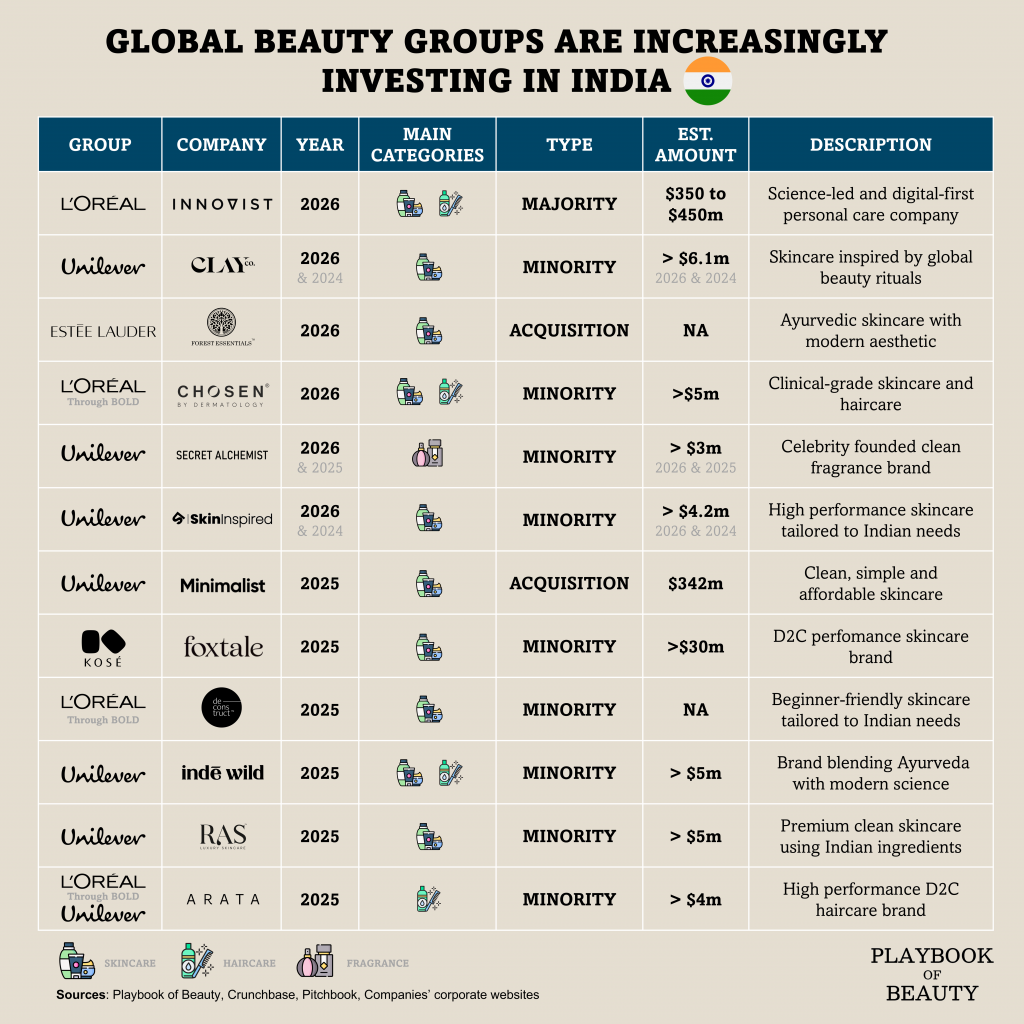
The confidence in India is supported by market data. Flipkart values the country’s B&PC market at approximately $27bn and expects it to reach $39bn by 2030 a nearly 10% CAGR, and global beauty groups are placing large bets on this growth potential. Unilever acquired Minimalist in 2025 in a transaction that valued the company at about $342m. It was then the largest deal in India’s beauty sector. In June 2026, L’Oréal signed an agreement to acquire a majority stake in Innovist, with press report estimating the price between $350m and $450m, exceeding the Minimalist transaction.
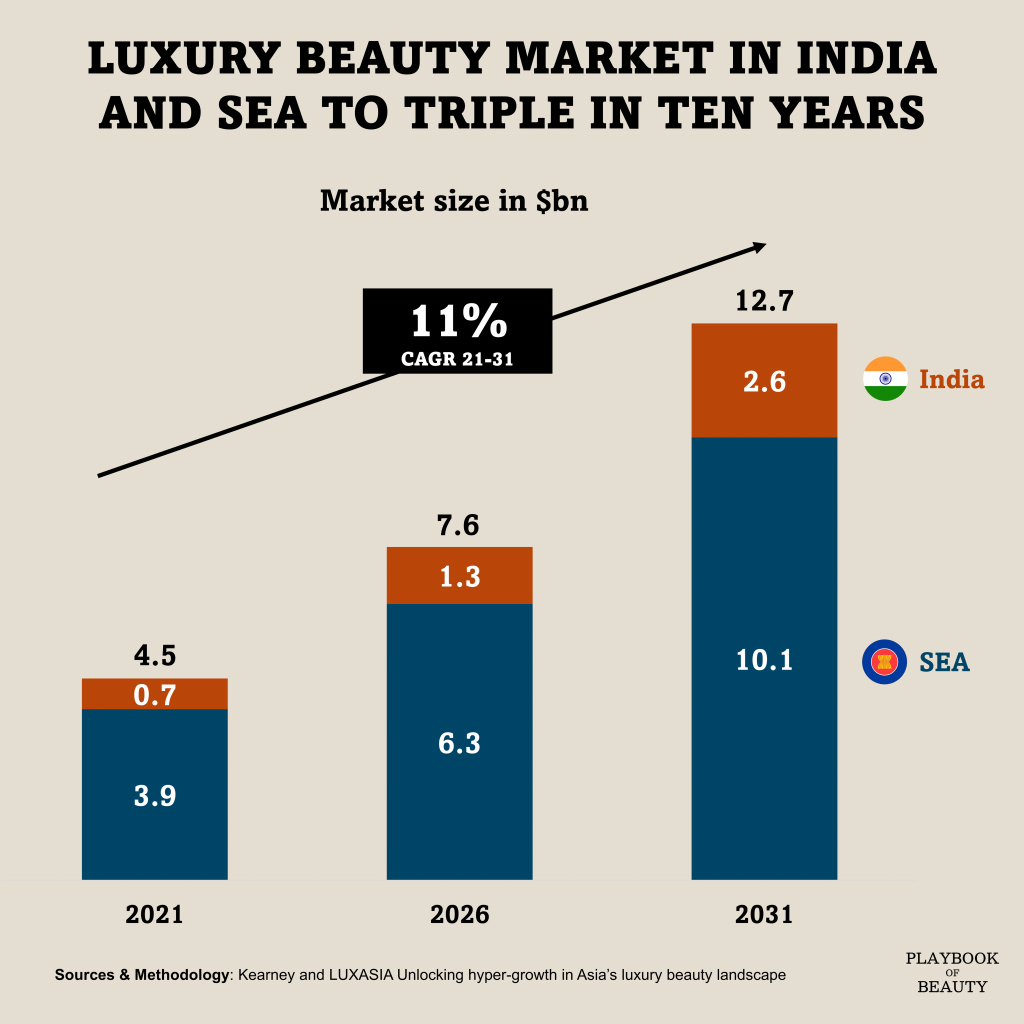
SEA offers a similar context of rising incomes and strong digital distribution. Kearney estimate that luxury beauty sales across SEA and India should reach $7.6bn in 2026, compared with $4.5bn in 2021. They forecast $12.7bn by 2031, equivalent to a 11% CAGR. Company results provide further evidence. L’Oréal’s broader SAPMENA–SSA region grew 10.9% on a LFL basis in 2025. Vietnam and Thailand were among the main contributors, while online sales were the main source of growth in SEA.
The Middle East was the highest-rated region in 2025. Due to the ongoing war and instability, it experienced an 18-point decline this year and dropped to 39%. But it still holds third place in the ranking which shows the incredible potential and resilience of the region.
Confidence in traditional Asian markets is decreasing. Korea and China are tied in fourth place at 30%. Both regions dropped 10 and 7pts respectively from last year. Japan saw a steeper decline. Only 12% of executives rate Japan as a high-growth market, down from 23% in 2025.
Europe receives an even weaker assessment. Western Europe fell 12pts to 7%, while Eastern Europe declined eight points to 4%. Circana data for 2025 explains this sentiment. The prestige market grew by 1% in Germany and declined by 1% in value and 3% in volume in France. A pessimistic consumer environment drives this contraction with 42% of French consumers planning to reduce their spending.
North America remains relatively steady at 24% a 1pt increase over 2025, with Circana data showing the US beauty market growing around 4.7% in 2025. Interestingly executives now rank North America’s growth potential behind Latin America which experienced a 6pts increase over 2025.
If mature beauty markets still remain the largest, the next phase of growth will come from India and Southeast Asia. Winning there will depend on local execution which explains the increasing investment of large groups in the region both acquiring local brands and building capabilities as shown by L’Oréal 2026 investment of $383 million in its Indian beauty tech hub.