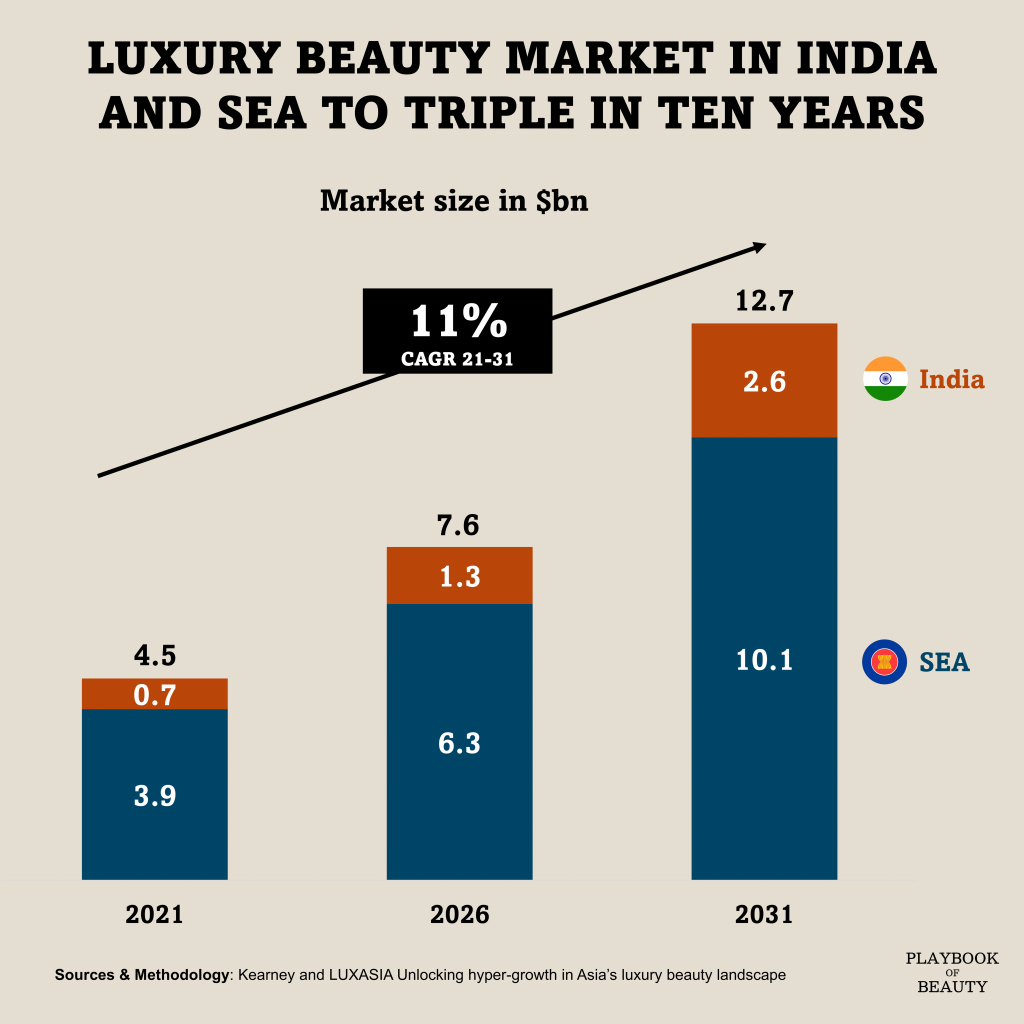
Kearney forecast that the luxury beauty market in India and Southeast Asia will grow from $4.5bn in 2021 to $7.6bn in 2026 and $12.7bn by 2031, an extra $1bn in luxury beauty spending every two years. That is an 11% CAGR and a 2.8x increase in ten years, compared with projected global growth of 4% to 6%. SEA is expected to grow from $3.9bn to $10.1bn, while India should grow from $0.7bn to $2.6bn.
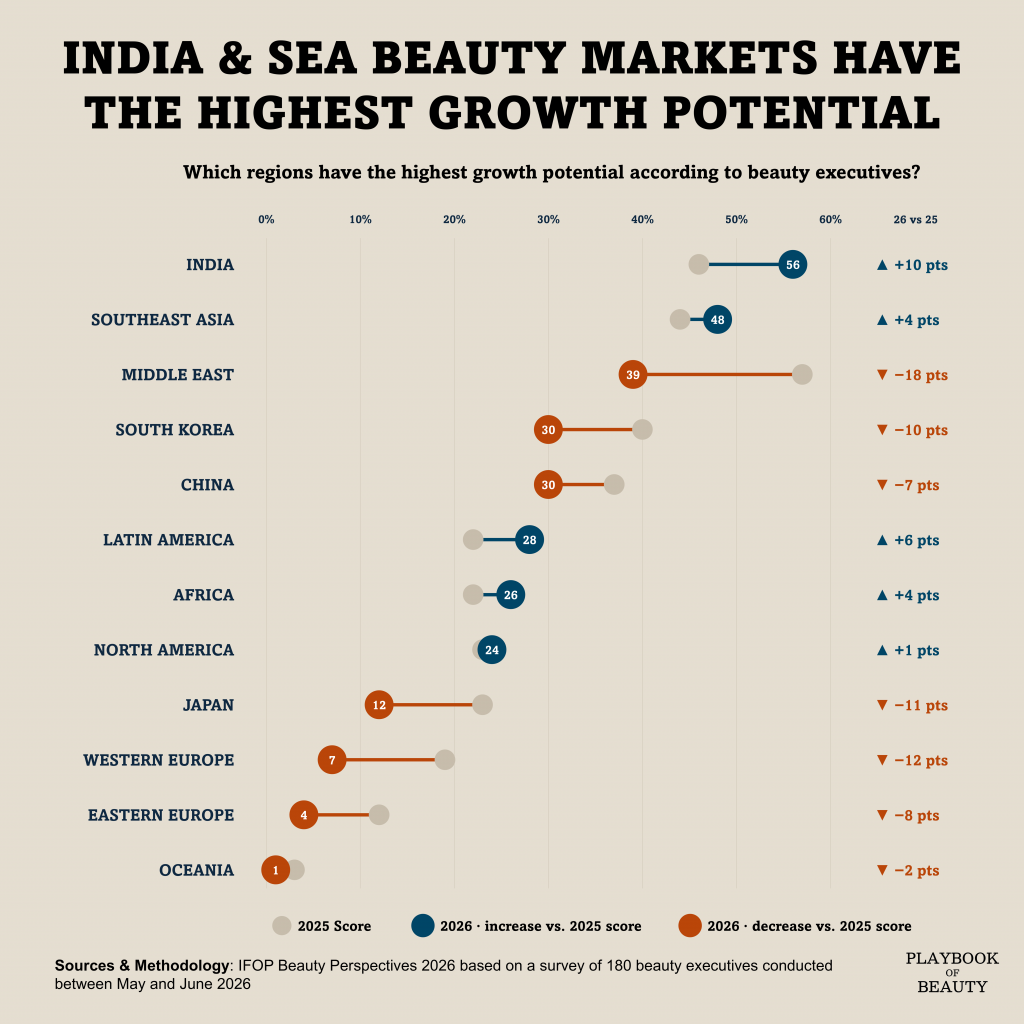
India and the six SEA markets covered by the report (Indonesia, Malaysia, Philippines, Singapore, Thailand and Vietnam) are expected to have a combined population of more than 2bn in 2026, including over 1bn middle and high-income consumers. Kearney sees the strongest potential in India, Thailand, Vietnam, Indonesia and the Philippines and global brands are forecast to capture 97% of the region’s luxury beauty market in 2026, compared with 61% in the more established markets of China, Japan and South Korea.
A key pillar of the industry growth in the region is digitalization. Google, Temasek and Bain estimated SEA’s digital economy exceeded $300 billion in GMV in 2025. 3 in 5 consumers now shop online and video commerce accounts for around a quarter of e-commerce GMV. For beauty brands, social media is becoming part of the transaction rather than a separate communications channel and according to Kearney, luxury beauty e-commerce was expected to grow at 15.6% annually in the region between 2022 and 2026. However physical retail remains the dominant channel in volume with more than 85% of luxury beauty sales in the region coming from offline channels.
Despite India and Southeast Asia sharing a fast-growing luxury beauty market this does not create a single regional consumer. Singapore has developed a strong niche-fragrance market, with brands such as Byredo, Creed, Diptyque, Jo Malone and Maison Francis Kurkdjian opening boutiques there. Malaysian skincare consumers tend to avoid heavy textures in the humid climate. Vietnamese fragrance buyers favour eau de parfum, while Indonesian consumers lean towards fuller makeup looks. American brands perform well in the Philippines, including among a growing male beauty audience. In India, makeup remains central, skincare routines are still comparatively restrained, and fragrance demand is strong.
The same differences apply to marketing. Limited-edition gifts can raise transaction values in Singapore. Samples and trial sizes recruit consumers in Malaysia. Reviews, vlogs and user-generated content influence purchases in Vietnam, while humour works well in Thailand. Indonesia relies heavily on social advertising and creator endorsements. Smaller formats and complimentary gifts suit the Philippines, while India is experiencing a “rise of minis” and value packs.
There is a regional opportunity for luxury beauty brands in Southeast Asia and India but as always brand will need strategy localized to each market to be successful in the region.