We are all increasingly relying on AI recommendations and the data backs it. According to PartnerCentric, nearly a third of US consumers say beauty is one of the categories where they expect to use AI tools to shop in 2026. This looks like a validation for the beauty industry players that have been increasingly investing in algorithmic skin diagnostics.
Following its acquisition of augmented reality startup ModiFace in 2018, L’Oréal built Vichy’s SkinConsultAI, a selfie-based tool trained on thousands of images that scores seven signs of aging and generates a personalized routine. At CES 2025, it went further by presenting Cell BioPrint, a cheek patch which can estimate the skin’s biological age in five minutes.
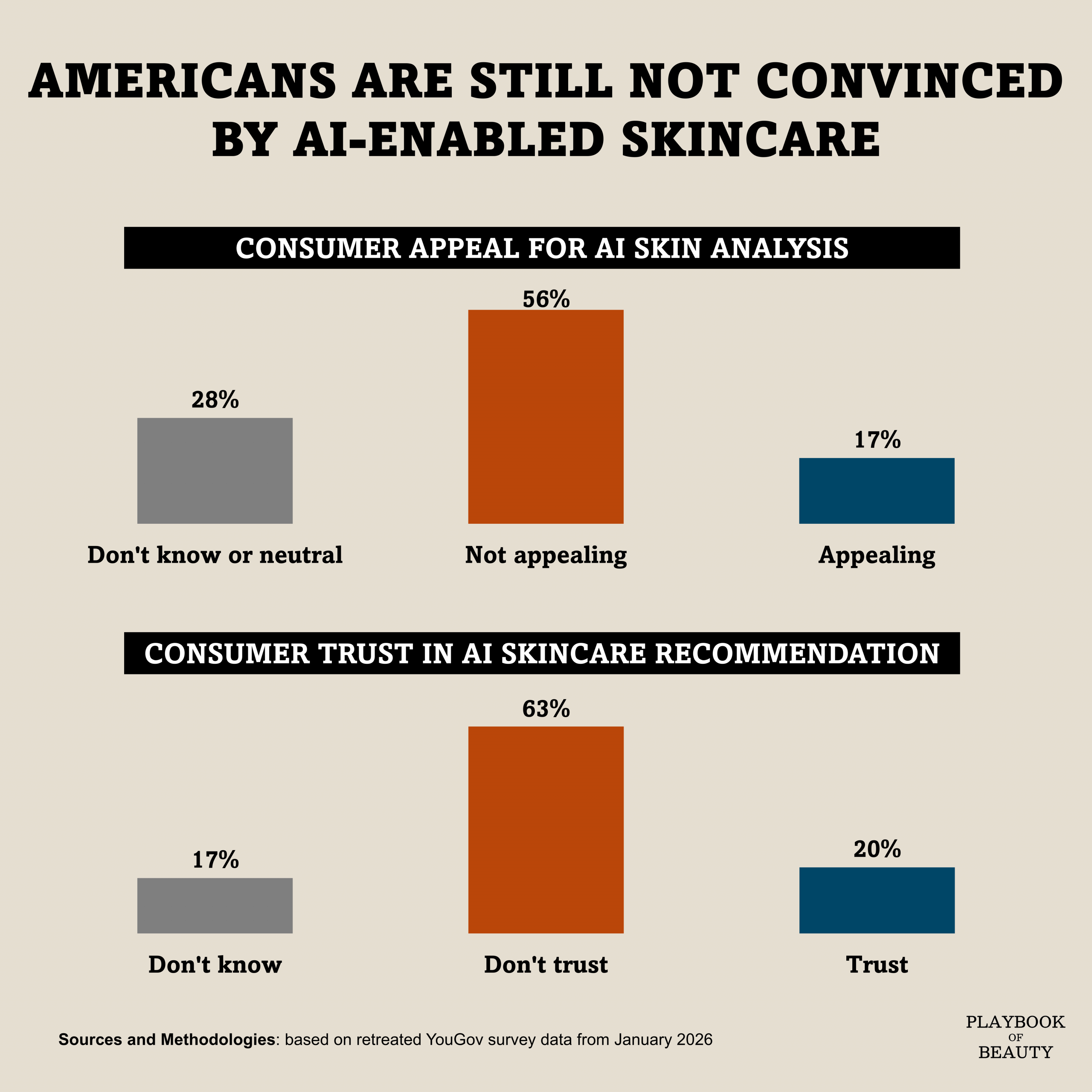
But paradoxically consumer sentiment hasn’t caught up for those specific tools despite seemingly widespread Ai adoption. According to data from YouGov from early 2026, 56% of US adults say AI skin analysis is not appealing to them versus 17% who find it appealing. Furthermore, 63% don’t trust AI skincare recommendations, against 20% who do. Even among the consumers most focused on preventing signs of aging, only 30% find the analysis appealing and 33% would trust it.
I believe that gap mainly comes from technical reasons. Diagnostics based on selfies still struggle in real life conditions. Lighting, camera distance, and facial angle all influence the outcome, when the underlying models have been trained on clinical photos taken in standardized conditions. A phone camera in a bathroom mirror is a very different input than a dermatologist’s lens, and this ultimately shows up as a trust problem.
But beauty has solved this kind of problem before. Virtual try-on went through years of similar skepticism before becoming what Ulta calls a “must-have” with its Glam Lab now drawing over 11 million visits and more than 80 million shade try-ons a year. AI skin diagnostics are probably on the same path. Accuracy will improve in the conditions consumers actually use, and trust and usage will follow.