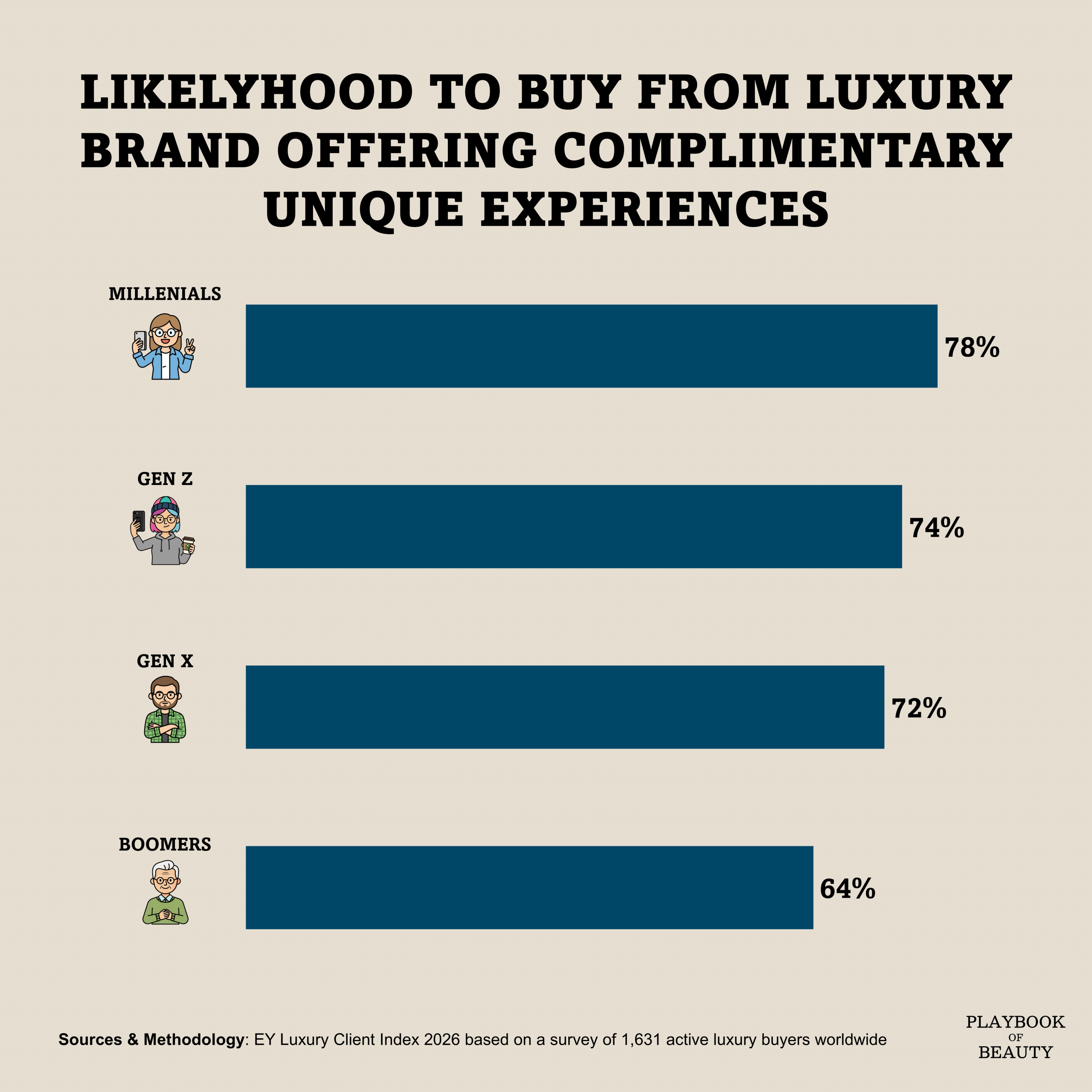
According to a survey conducted by EY in 2026, 74% of luxury clients are more likely to buy or buy again from a brand that offers a complementary experience to its product like early access to new releases, invitations to events or personal styling sessions. If all generation predominantly value those experiences, they do have more impact on millennials (78%) than on baby boomers (64%).
But what is striking to me and where lies an untapped opportunity for brands is that the same report finds a persistent shortfall in how experiences are delivered. 30% of aspirational luxury clients say they received no experience at all in the past twelve months, seven points higher than the year before. The gap is even bigger for entry-level spenders (43%) and the least frequent buyers (55%). There are also major differences by geographies. In the UK, 41% of clients did not get any complementary experience in the past year and 38% in the US. Mainland China (80%), France (76%) and Germany (76%) sit at the other end, with clients being offered experiences much more consistently. Baby boomers are also the group least likely to have been offered anything, at 46%, even though they are still nearly two thirds to value experience.
When brands offer a complementary experience, it is generally going to be exclusive access to limited editions (36%), personalized product recommendations (33%), or private shopping appointments (32%) each giving clients a sense of and individual attention. When looking at clients’ preferences 68% want access to limited editions, 61% want travel or lifestyle experiences, and 52% want private shopping. Atelier visits, which are still uncommon, are getting interest from customers in Spain (52%), France (51%) and Switzerland (50%), showing the importance tailoring experiences to each market.
While the EY survey covers only fashion and watches and jewellery the same logic should apply to beauty and with even more force given the experiential and sensorial dimension of beauty. And this is already showing up in the budgets of beauty brands. Gradient’s 2024 State of Experiential Marketing report found that 84% of beauty and skincare brands increased their experiential spending over the previous three years, and two-thirds now put between 10% and 30% of their marketing budget into this kind of activation.
The data shows where brands need to focus in the future: fewer big one-off moments, more consistent access and closer attention to the clients, entry-level spenders, infrequent buyers, older generations, that brands still overlook but could be turned into increasingly loyal customers.