Based on ITC Trademap export data covering skincare, makeup, fragrance and haircare, the UAE was by far the fastest growing beauty exporter globally with an estimated 27.1% CAGR between 2016 and 2025 driven by Dubai’s emergence as a fragrance re-export hub and original production center. Luxury fragrance in the Gulf region grew 11% in 2024 alone per Chalhoub Group, while Emirati mass brand Lattafa was the top selling fragrance brand on Amazon in Q1 2026 according to Pattern.
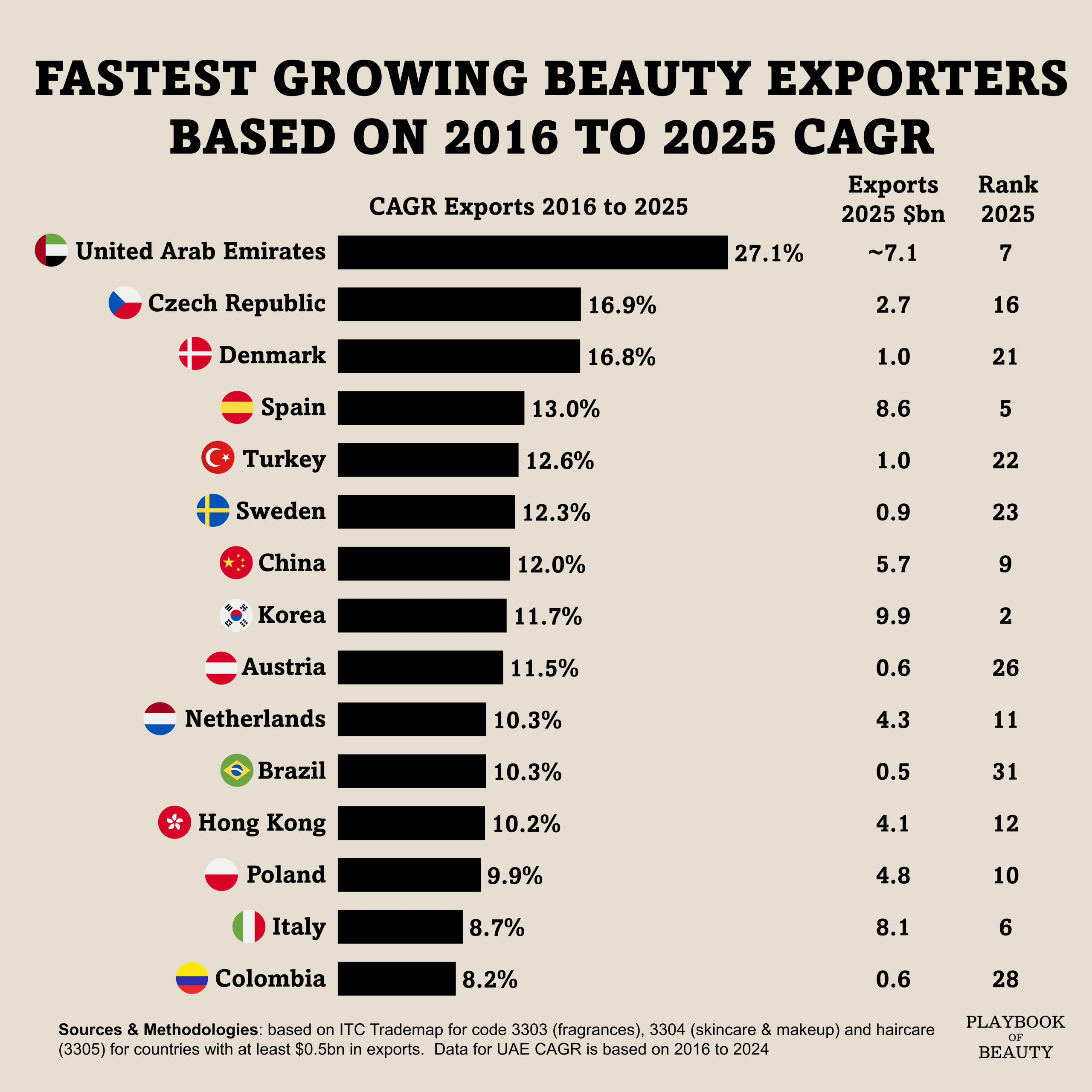
The Czech Republic, number two at 16.9% CAGR, is probably the ranking’s most underreported entry. The country has become a significant manufacturing base for global beauty groups seeking lower-cost EU production with full regulatory compliance, a structural advantage that is unlikely to reverse.
Denmark, third at 16.8% CAGR, owes its position largely to Novo Nordisk’s beauty-adjacent dermatology pipeline and a cluster of Scandinavian clean beauty brands that have scaled internationally
Spain at 13.0% CAGR tracks directly onto one corporate champion Puig, which grew 12.7% per year between 2015 and 2025 closely mirroring Spanish beauty exports.
China at 12.0% CAGR and $5.7 billion in 2025 exports reflects both the maturation of domestic brands like Florasis and Proya into export-capable businesses, and a growing contract manufacturing role for global groups.
Korea at 11.7% CAGR needs little explanation with now $9.9 billion in annual exports and the top beauty exporter to the US in 2025.
Poland at 9.9% and $4.8 billion reflects a decade of investment by L’Oréal, Coty and Beiersdorf in Central European production, combined with domestic mass-market brand growth.
Finally Sweden at 12.3% punches above its size through Byredo and a cluster of clinical skincare brands with strong European and North American traction.
I reckon the ranking mainly reflects two growth models: countries built around one or two dominant champions (Spain via Puig, UAE via fragrance infrastructure, Korea via APR Corp. and Amorepacific), and countries that grew through manufacturing ecosystems (Czech Republic, Poland). The champion-driven model delivers faster growth but carries more concentrated risk as Spain’s export figures would look very different without Puig.