Based on Euromonitor estimates published in 2026 and cited by BeautyMatter and Beautyworld Middle East in their 2026 GCC in focus report, the ten top growing beauty e-commerce markets are expected to generate around $37.5bn in extra beauty e-commerce sales between 2025 and 2030.
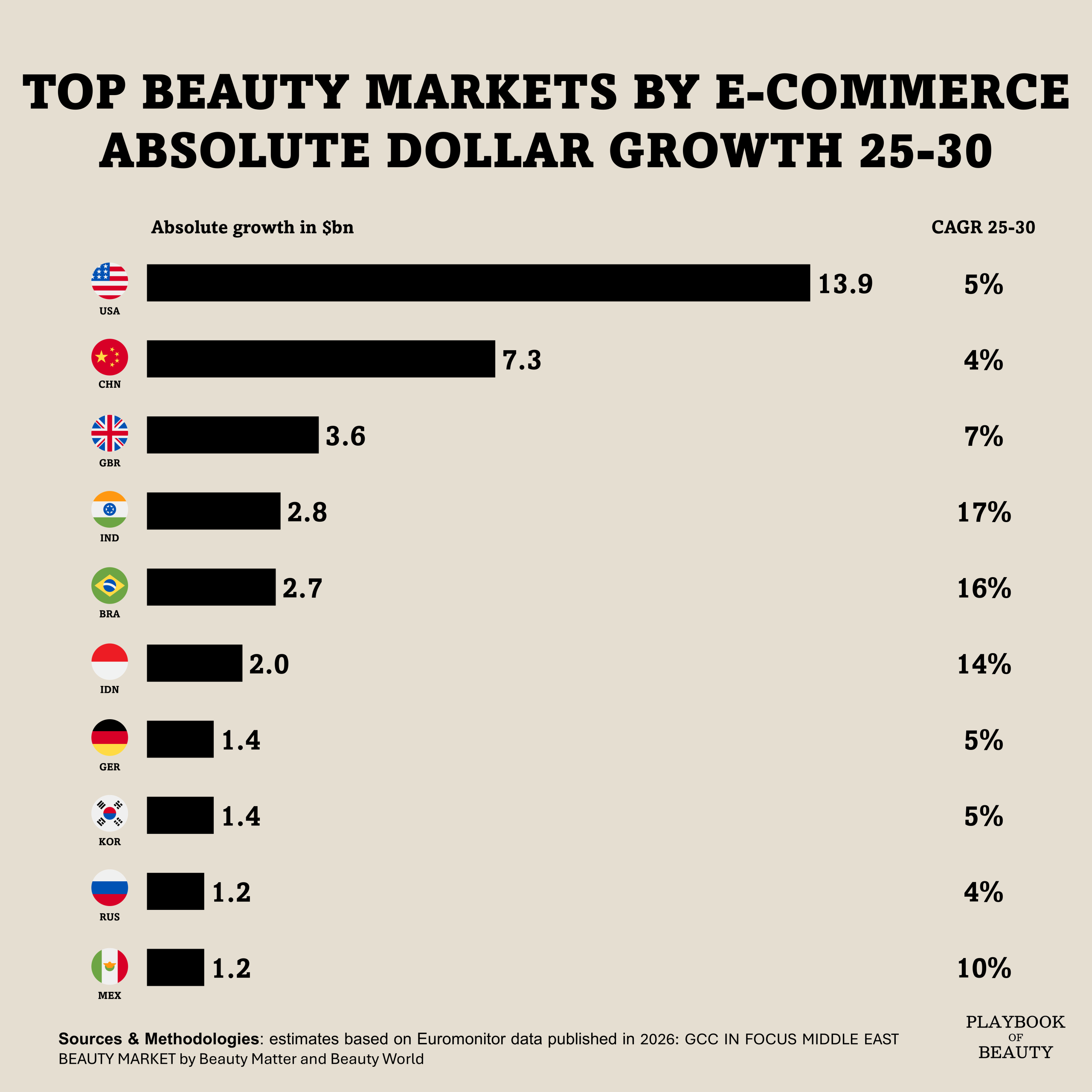
The US and China will bring the largest incremental sales contributing $21.2bn, or 57% of that increase while India, Brazil, Indonesia and Mexico are the fastest growing market with double digit growth.
The US remains in a class of its own with $13.9bn of additional online sales despite a relatively mature 5% CAGR. Amazon’s push into prestige beauty, the rise of TikTok Shop and the strength of Ulta and Sephora’s loyalty ecosystems are giving an already large market more ways to grow.
China adds another $7.3bn at 4%. The pace is slower, but the channel mix is changing quickly. Growth is moving from Tmall and JD.com towards Douyin and live commerce, while domestic brands such as Proya, Florasis and Winona are taking share from global player through faster product development and more locally relevant marketing.
The UK is an interesting case as it is the mature market with the highest CAGR at 7%, the country having one of the highest online beauty penetration in the world.
India is the fastest-growing market in the ranking, adding $2.8bn at a 17% CAGR. Nykaa and newer beauty specialists are building trust through curation and authenticity, while Blinkit, Zepto and Instamart are turning beauty into an impulse, quick-commerce purchase. Redseer also estimates that more than 60% of new beauty shoppers now come from outside India’s largest cities.
Brazil is close behind at $2.7bn and 16%. Its large fragrance and haircare markets are moving online as Natura, Avon and O Boticário digitize their consultant networks, while Mercado Livre and Shopee expand local fulfilment.
Indonesia adds $2.0bn at 14%. TikTok Shop and Tokopedia have made video and live commerce central to product discovery, while halal-certified, climate-adapted local brands such as Wardah and Somethinc are growing with the channel.
Germany and South Korea each add $1.4bn at 5%, but for different reasons. Germany’s online market is shaped by Douglas, digital pharmacies and demand for clinically supported products. South Korea is already highly digital, with Olive Young using its store network and rapid delivery to connect online convenience with physical retail.
Mexico and Russia each contribute $1.2bn, but Mexico grows much faster: 10% versus 4%. In Mexico, marketplaces and alternative payment methods are bringing more consumers online despite relatively low credit-card penetration.