Beiersdorf’s H1 26 group sales fell to €4.952 billion, down -4.5% reported and -3.5% organically. Q2 slightly improved at -1.1% reported and -2.3% organically, but management still cut the full-year outlook. Adjusted EBIT fell 8.1% to €768 million and the margin dropped 60 basis points to 15.5%. Profit after tax was broadly flat at €558 million, while free cash flow improved to €199 million from a restated €71 million outflow a year earlier.
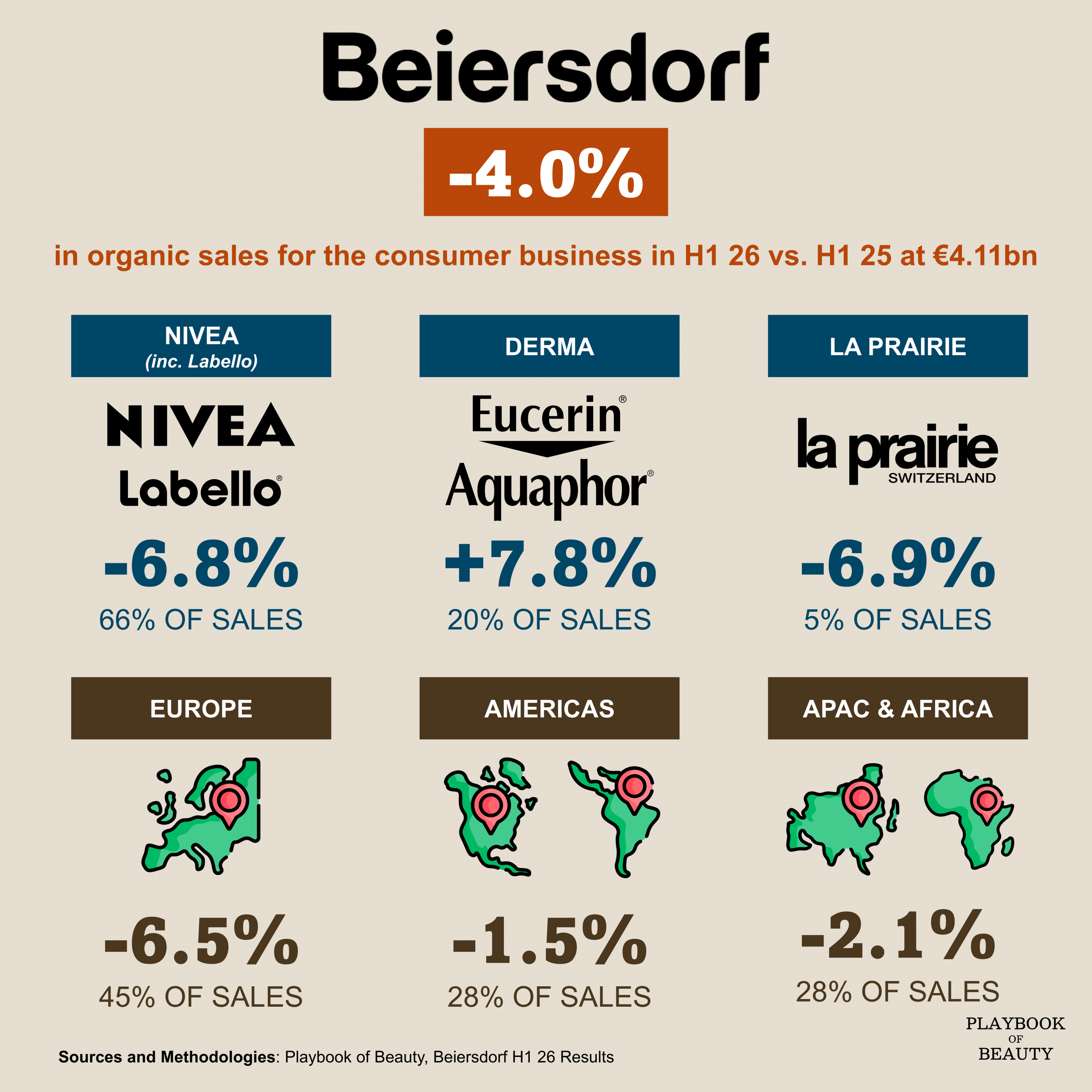
The consumer division, which accounts for 83% of group sales, declined 5.0% reported and 4.0% organically to €4.113 billion. Its adjusted EBIT margin also fell 60 basis points to 15.4%. NIVEA and Labello were the main drag, down 6.8% organically in H1 and 6.7% in Q2. Beiersdorf says sales were held back by temporary disputes with retail customers, a late start to the European sun season, retailers reducing inventory, and the timing of new product launches. NIVEA’s sell-out growth remained positive in H1, but the company says the positive market-share and volume signals remain too isolated to improve performance globally.
Perfomance in the derma category partly offset Nivea’s under performance. Eucerin and Aquaphor grew 7.8% organically in H1 and 7.4% in Q2, with Beiersdorf citing Epicelline and Thiamidol innovation and growth in North America, Brazil and China as the main driver.
La Prairie fell 6.9% in H1 but returned to growth at +2.2% organically in Q2 as temporary U.S. department-store and China travel-retail disruptions faded.
Beiersdorf has cut its 2026 outlook from flat to slightly positive organic growth to a low-single-digit organic sales decline for both the Group and Consumer division. It now expects an adjusted Group EBIT margin of at least 11.8% and will add €100 million to NIVEA media spend in H2 versus H2 2025 to fund the brand recovery, with management targeting a return to group sales growth in 2027 and profitable growth from 2028.