According to data from Spate, the leading AI-powered consumer trend intelligence platform, L’Oréal owns four of the ten most popular skincare brands online over the past twelve months, based on combined activity across Google, TikTok and Instagram. The group also holds the top two spots with La Roche-Posay and CeraVe, which also happen to be the two best-selling skincare brands on Amazon. No other group places more than one brand in the ranking. Estée Lauder has The Ordinary in number 3, Johnson & Johnson has Neutrogena in sixth spot, Galderma has Cetaphil in number 7 and Pierre Fabre has Avène in last position.
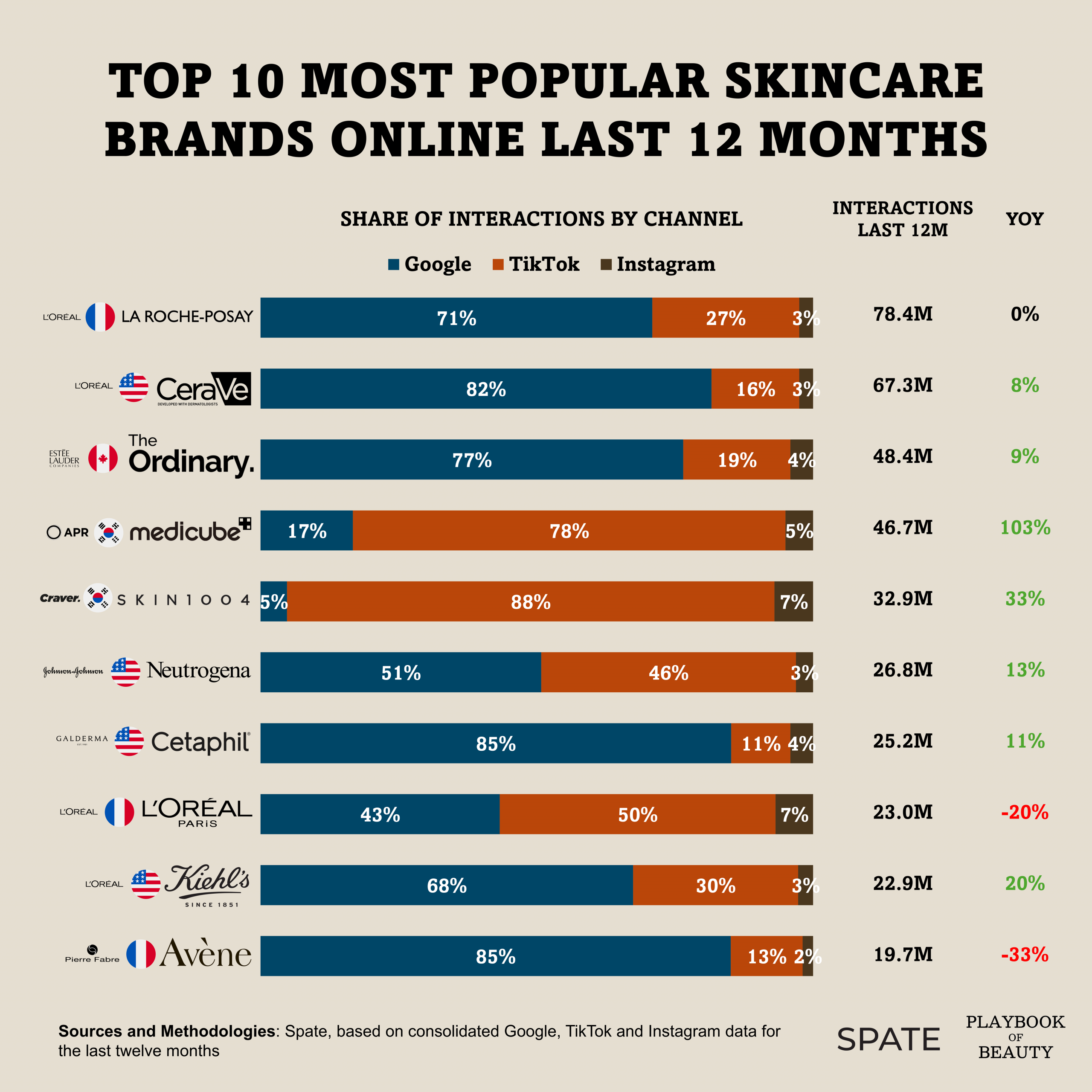
But what caught my attention is who else made it in the ranking. Medicube and Skin1004, neither backed by a large group, sit in the same top ten. Both are Korean, founded in 2017 and 2012. Apart from The Ordinary (2013) and CeraVe (2005), every other brand on the list has more than fifty years of existence.
So how did two relatively young, independent brands got there? The short answer is TikTok. It drove 78% of Medicube’s online interactions over the period and 88% of Skin1004’s, the two highest shares on the list by far.
Medicube’s momentum really started in July 2023 with an organic mention. Hailey Bieber used the brand’s Booster Pro device in a TikTok video without being sponsored by the brand and the clip drew a million likes. When Kylie Jenner later posted about the same device, Medicube sponsored hundreds of reaction videos from micro influencers filming themselves watching her clip and testing the device with content built to look organic.
Skin1004 started with micro and nano influencers before bringing in bigger names and built its content around its core ingredient, Centella Asiatica sourced from Madagascar. It then used TikTok Shop’s video and livestream shopping ads to convert awareness into sales.
When comparing those brands with the rest of the ranking L’Oréal Paris is the only legacy brand which gets most of its visibility from TikTok, at 50%. The other legacy brands average 72% of their interactions from Google Search, 25% from TikTok and 3% from Instagram.
Should legacy brands focus more on TikTok then? Not necessarily as it notably depends on their target audience. According to Provoke Insights, the top two discovery channels for Gen Z are social media (44%) and short-form video (26%). For Boomers, they are television (36%) and search engines (31%). Millennials lean on social media (38%) and search engines (25%) while short-form video does not even make their top five.
What this ranking ultimately shows is that TikTok is really redistributing the cards in beauty and with the right strategy, indie brand can now rival in popularity with established brands.