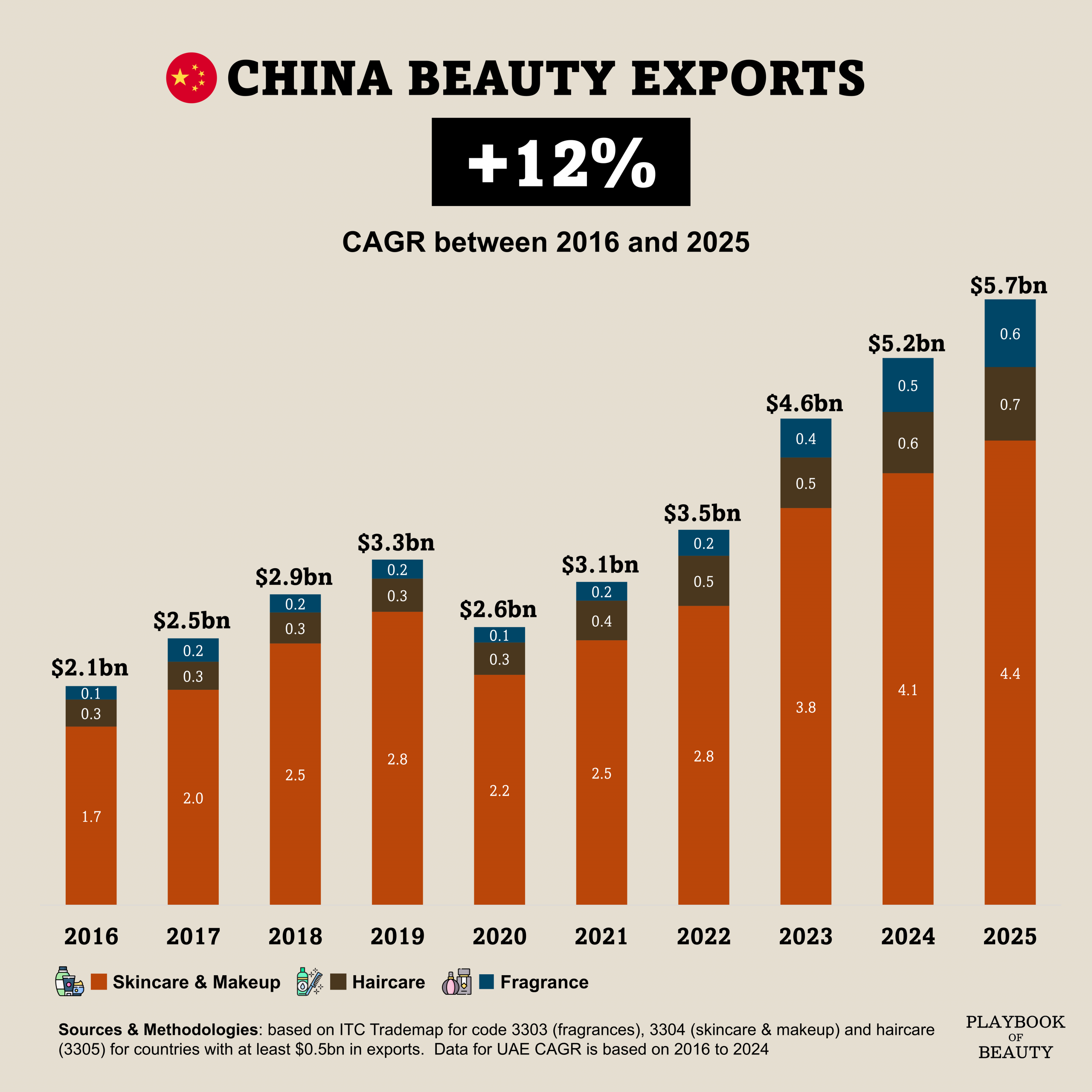
China climbed from 12th to 9th in global beauty export rankings between 2016 and 2025, at a CAGR of 12% slightly ahead of Korea’s 11.7% over the same period. China is still only a quarter of French exports and 60% of American beauty exports but it has been growing twice as fast as France and 6 times as fast as the USA over the last ten years based on data from ITC Trademap. Chinese beauty exports reached $5.7bn in 2025 with skincare and makeup accounting for nearly 80% of exports. Fragrance, long a marginal category in China has grown from $0.1bn to $0.6bn over the same period. The main destination countries in 2025 for Chinese skincare and makeup exports were notably the United States, the United Kingdom, Indonesia, the Netherlands, France and Japan. According to Alibaba.com, North America remains the largest B2B cross-border destination, with the US accounting for nearly a quarter of orders, growing 30% annually.
This rise of Chinese beauty exports has a dual origin. Part of it is Chinese beauty brands such as Florasis, Proya and Judydoll going global and another part is global beauty companies manufacturing in China. China has over 6,000 registered cosmetic manufacturers and is estimated to serve more than 60% of the world’s white label and private label beauty products. Cosmax, one the world’s largest cosmetics ODM, runs seven facilities in China with annual production capacity of 1.5 billion units, serving around 1,000 Chinese clients its second-largest base globally including both Florasis and L’Oréal.
On the Chinese brands side, two names are worth naming: Florasis and Proya. Florasis opened a counter at Samaritaine in Paris in late 2024 becoming the only Chinese beauty brand with a physical presence in Europe then launched a flagship at Ginza Six in Tokyo in January 2025. One Florasis lipstick, priced above its Chanel equivalent, ranked among the top three lipstick sellers on Amazon Japan at launch. Regarding, Proya it is not only exporting its products but also spending in R&D abroad. Its R&D spend nearly tripled between 2020 and 2024, rising to 210 million yuan (~$30m), and it opened a Paris innovation center recruiting scientists from global beauty firms.
C-Beauty built its first decade on price and supply-chain depth, but today Chinese contract manufacturers are moving up the value chain while Chinese brands are opening flagships in global cities. It looks like an increasing part of formulation, IP and brand equity will now stay in China rather than passing through it.