
Data from Pattern, the leading e-commerce accelerator, give valuable insights on Amazon’s global beauty trends in Q4 2025. The gifting season saw shoppers move away from experimental viral trends toward more established trust, clinical efficacy, and high-value tools. The market exhibited a bifurcation, with luxury brands winning in gifting categories like fragrance, while “masstige” and clinical brands dominated daily-use skincare and hair tools.
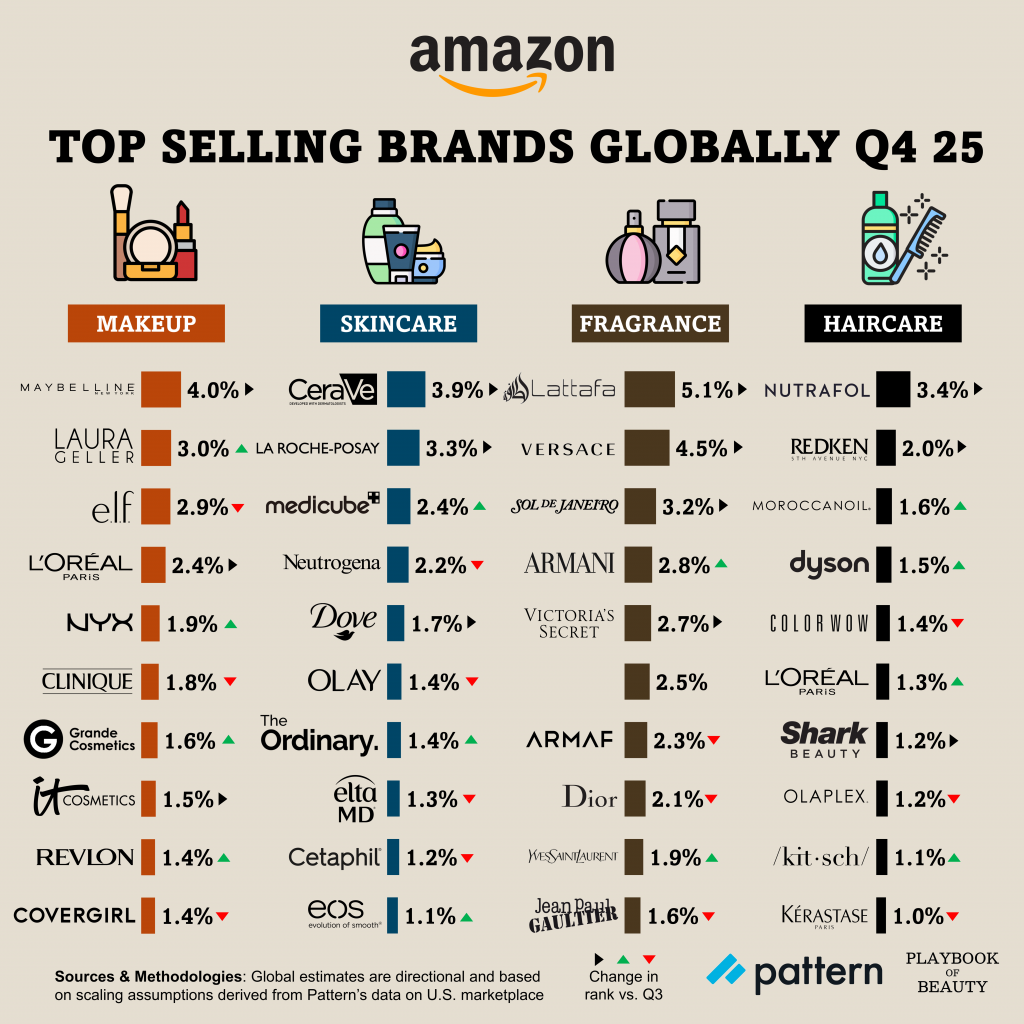
In makeup, the top ten brands collectively lost significant market share, declining from 30.3% to 21.8%. This indicates intense category competition and growth among smaller entrants. Laura Geller surpassed e.l.f. by executing a hyper-focused “Mature Skin” strategy, appealing to higher-spending gift-givers with kits like its “Holiday Baked Starter Kits”. Concurrently, Revlon replaced Lancôme in the top ten which can be attributed to Revlon’s full-funnel ad strategy utilizing Amazon Marketing Cloud.
The skincare category saw its top ten brands slightly increase market share from 19.2% to 19.8%. CeraVe and La Roche-Posay consolidated their leads respectively gaining 0.5 and 10.1 points in market share, while Medicube ascended to the third rank reinforcing the “clinical” trend. Medicube is 2025’s rising star, driven by the “at-home aesthetician” trend and aggressive discounting on devices like the Age-R Booster Pro. EOS entered the rankings, replacing COSRX, a seasonal swap we can attribute to winter demand for heavy-duty body hydration over “glass skin” serums.
Fragrance presented a reversal with luxury houses Armani, Saint Laurent, and Dior all gaining market share, while the budget “dupe” brand Lattafa lost 1.2 points in market share while still keeping the first spot in the ranking. This shows consumers might buy dupes for themselves but gift authentic luxury perfumes during the holidays. Sol de Janeiro held steady, remaining the “Safe Gen Z Gift” due to its established social currency.
Haircare remains the least concentrated category, with the top ten holding just 15.6% market share. The quarter was defined by a “tool & accessory” takeover. Shark Beauty entered the top ten by positioning its FlexStyle as a smart swap for Dyson’s premium tools. Kitsch also entered the top 10, capitalizing on the viral “heatless hair” trend with affordable accessories. Conversely, Olaplex fell to seventh, a drop we can connect to “bond-building fatigue” and rising competition from brands like K18.
The data shows that Q4 requires a distinct strategy from the rest of the year, one that prioritizes perceived value and giftability over viral novelty. Amazon is no longer just a channel for discovery and replenishment. It has matured into a decisive arena for high-stakes seasonal spending, where brand equity and strategic positioning matter.