
Data from Navigo Marketing on Ulta’s top-selling brands in 2025 present a nuanced portrait of the American beauty consumer.
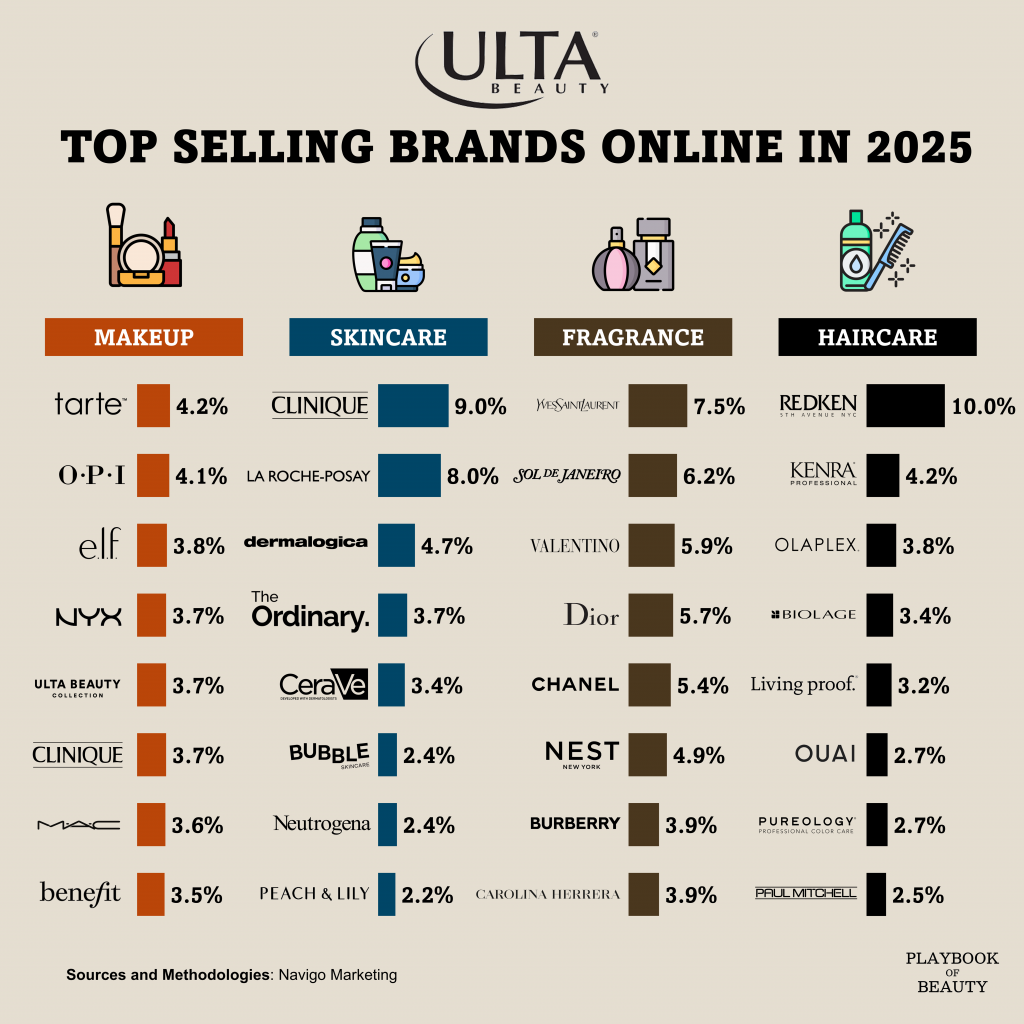
The makeup category is the least concentrated, with its top eight brands holding 30.3% share, and is the only one to features Ulta’s own brand. Tarte leads despite a 0.6pts YoY share erosion, while OPI and E.L.F. experienced the strongest growth at 0.6pts YoT. This list, including Benefit, MAC, Clinique, NYX, and e.l.f., perfectly illustrates Ulta’s successful high-low model, catering to a hybrid shopper who mixes prestige and mass-market items freely.
The skincare ranking, where the top eight hold 35.8% share, signals a shift toward clinical efficacy. Leaders Clinique and La Roche-Posay, which saw significant growth YoY (respectively 1.7pts and 3.2pts) tied to high ad spend, top a list dominated by dermatological brands like CeraVe, The Ordinary, and Dermalogica. The presence of Peach & Lily and Bubble highlights the maturation of K-Beauty and the emergence of a science-focused Gen Z. Here, consumers treat skincare as healthcare, prioritizing ingredient transparency and trusted professional recommendations.
In contrast, fragrance is the most concentrated category at 43.4% share and is dominated by luxury. The list, featuring Carolina Herrera, Chanel, Dior, and Valentino, shows consumers treating scent as an accessible luxury accessory. Notably, Sol de Janeiro and Nest New York achieved major share gains without heavy advertising, while Dior and Chanel lost ground (respectively -0.2pts and 2.4pts) despite increased ad spend. This underscores the growing power of viral and gourmand fragrance over traditional marketing in this segment.
Haircare completes the picture, with its top eight holding 32.5% share and defined entirely by professional or salon-heritage brands like Paul Mitchell, Pureology, and Olaplex. This category reflects exceptional consumer loyalty and a willingness to invest in premium, reparative formulas, revealing a market where professional authority and proven results outweigh trends.
I reckon this data reveals a strategic landscape where Ulta’s model of aggregation is key. The retailer simultaneously serves a pragmatic, price-aware consumer in makeup and skincare, and a status-seeking one in fragrance, while leveraging professional trust in haircare. Legacy groups like Estée Lauder and L’Oréal maintain strong footholds, but growth dynamics highlight the rising threat of agile, digitally-native brands and the shifting ROI of traditional advertising. Ultimately, the 2025 rankings confirm that the modern beauty customer is segmented not by loyalty to a single tier, but by a strategic, category-specific approach to value, efficacy, and identity.