
Spate’s latest ranking of the most successful beauty brands on social media give valuable insights on the trends that dominated 2025. Amogn the top ten, American labels claim five spots, while Korean brands capture two. Independent players dominated, with seven of the ten players operating without conglomerate backing. Skincare remains the top category, represented by five brands, followed by haircare with three brands.
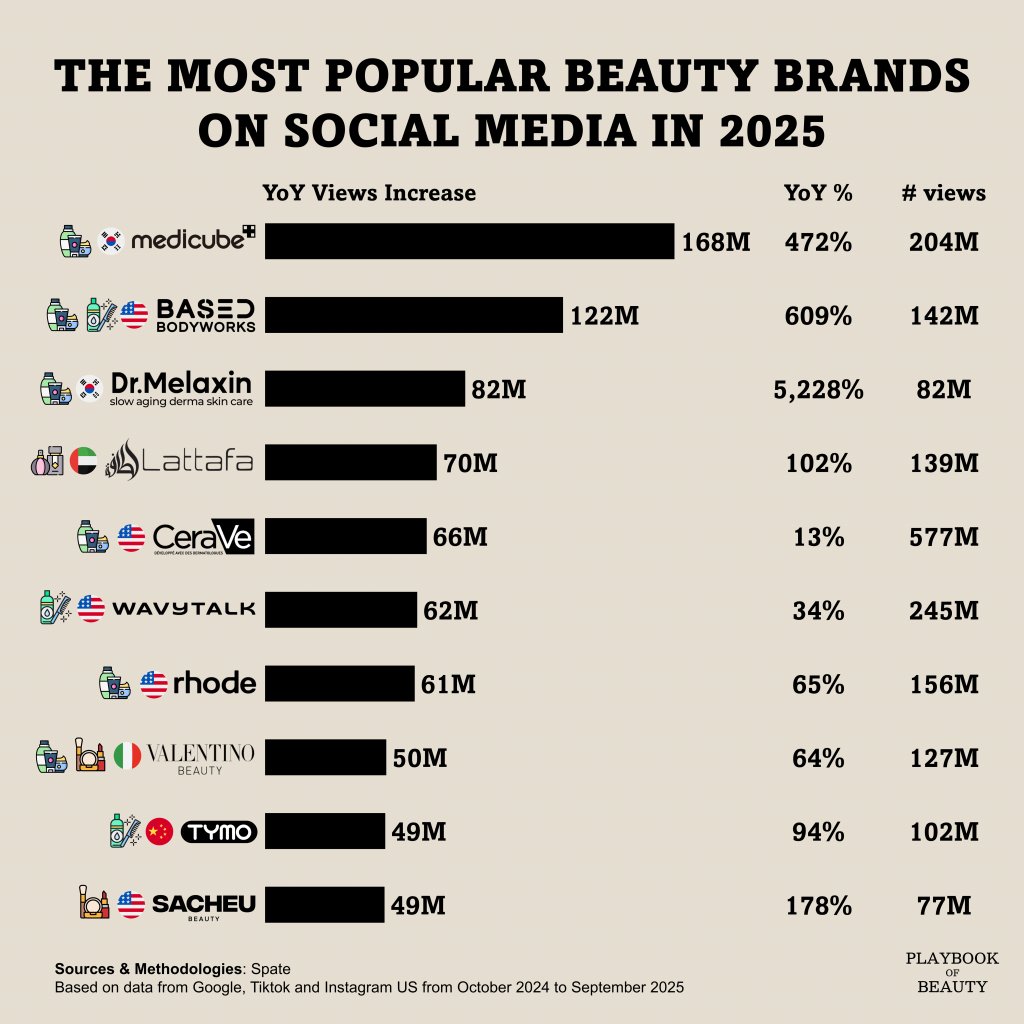
Three structural trends emerge from the ranking. First, the “clinic-at-home” segment has matured. Medicube and Dr. Melaxin signal a consumer shift from passive moisturizing to active intervention, embracing delivery systems once reserved for professional settings.
Second, male beauty continues to accelerate with Based Bodyworks reflecting a culture where young male consumers are increasingly scrutinize ingredients. Third, the dupe economy is rising. Wavytalk and Tymo proved hardware doesn’t need a $600 price tag to deliver results, leveraging TikTok Shop to democratize tools that rival Dyson’s engineering, while on the perfume side Lattafa dominates the dupe category.
Medicube’s ascent, ranking first overall and becoming Amazon’s third top-selling brand in Q4 2025 according to Pattern®‘s data, merits a particular focus. The Korean label has engineered virality rather than chasing it. Its strategy rests on three pillars: clinical anchoring, device-led differentiation, and affiliate infrastructure. Rather than riding the glass-skin trend, Medicube built momentum around problem-solution specificity, most notably with Zero Pore Pads and Age-R devices. On TikTok, it recognized early that peer-to-peer reviewing, not influencer endorsements alone, drives trust. With nearly 34,000 affiliate creators and a founder who engages directly as “CEOppa,” Medicube converted social proof into a distributed salesforce. The result: $1.1bn in 2025 revenue and a seamless transition from TikTok Shop to 1,400 Ulta doors.