
The next battleground for beauty brands isn’t search rankings or social media feeds: it’s the answer an AI gives when a consumer types “what skincare routine should I start.”
The next battleground for beauty brands isn’t search rankings or social media feeds: it’s the answer an AI gives when a consumer types “what skincare routine should I start.”
Generative Engine Optimization (GEO) is the emerging discipline of ensuring a brand appears in AI-generated recommendations, and in beauty, where purchase decisions relies on trust, the stakes are high. Unlike SEO, which rewards link architecture, GEO rewards something harder to build: the degree to which a brand has become part of the consensus in scientific, editorial, and community discussions.
To test where brands actually stand, we ran 250 varied prompts per product category across Claude, ChatGPT, and Gemini, recording which brands appeared in each response.
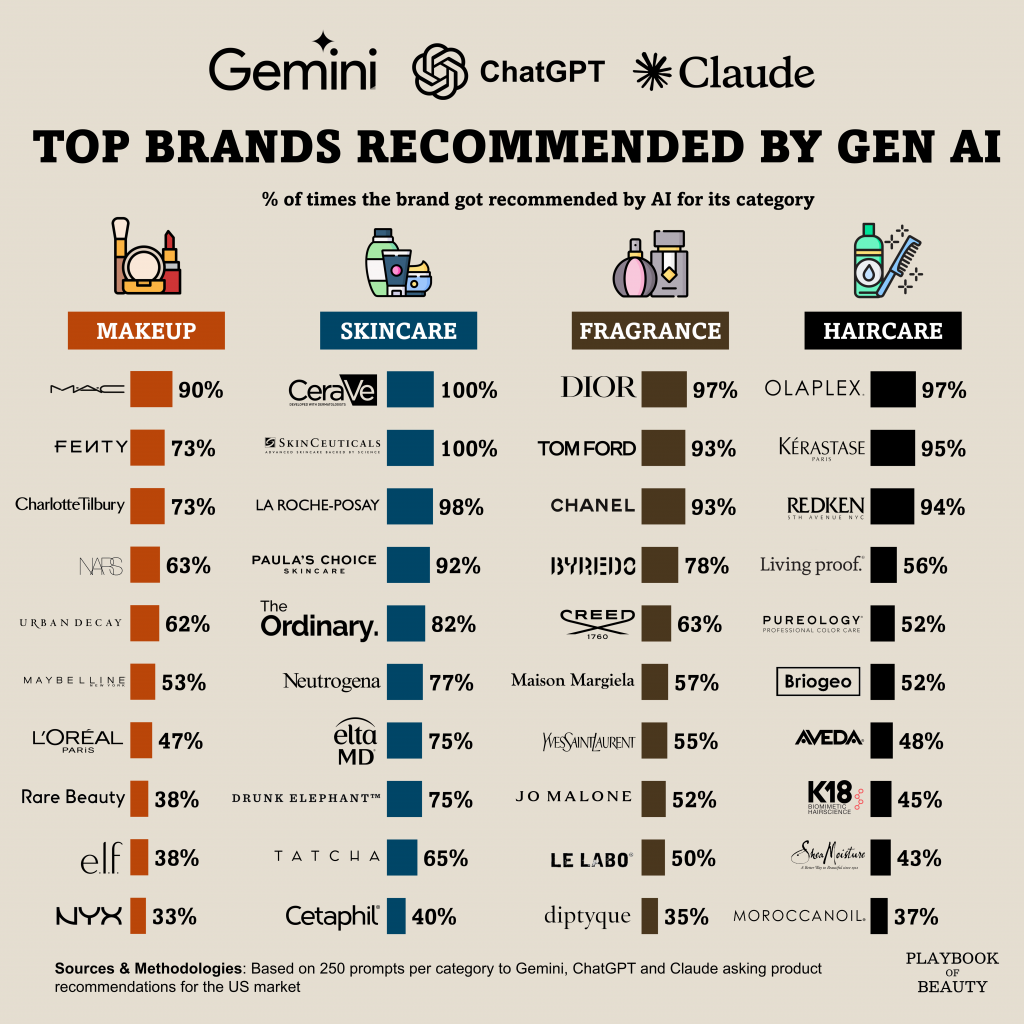
In skincare, SkinCeuticals and CeraVe each appeared in 100% of responses across all three models. Their dominance traces back to dermatologist citations, clinical literature, and pharmaceutical heritage: assets that compound over decades and translate directly into the AI recommendations. Drunk Elephant, despite its cultural moment, sits at a 75% average, visible but not yet institutionally embedded the way the clinical players are.
Fragrance tells a more polarized story. Dior, Chanel, and Tom Ford cluster between 93–97% average because of their cultural importance in luxury. But Creed scores 100% with Claude and Gemini yet 0% with ChatGPT, a brand that dominates connoisseur editorial and specialist communities, content ecosystems that some models weight more than others.
In makeup, NYX achieves 100% with Claude but 0% with ChatGPT and Gemini, pointing to a brand built inside tutorial culture and Reddit communities but not yet present in the cross-platform authoritative sources all models agree on. MAC, with three decades of professional industry presence, holds at 90% across all three, proof that longevity creates an unfair advantage with GEO.
I reckon this data shows an emerging pattern: AI recommendations are a direct readout of where a brand lives in high-quality, high-frequency, cross-platform text. For the growing share of consumers who begin their purchase journey with a prompt rather than a Google search, clinical validation, press coverage, and professional endorsement determine whether a brand exists in the conversation at all.