LVMH does not disclose Sephora’s revenue, but the Selective Retailing division gives us enough to triangulate. The division reached €18.35bn in 2025, up just 2.6% reported and 4% organic, against €17.89bn in 2024. Sephora made an estimated €16.4bn last year according to LSA, meaning it already represented roughly 92% of the division. The remaining €1.5bn comes from DFS, Le Bon Marché, and Starboard Cruise Services.
The 2025 commentary from LVMH is where the math gets interesting. DFS is described as still held back by international travel headwinds, with profitability improving through cost discipline rather than top-line growth. Le Bon Marché grew but is too small to matter at scale, sitting around €200-250m. That leaves Sephora to carry essentially all of the division’s €465m absolute growth.
The language also shifted. In 2024, LVMH described Sephora’s growth as double-digit. In 2025, it became solid growth, which we can read as a step down to mid-to-high single digits. Combined with around a hundred new store openings and the Rhode launch landing as a record-breaking debut, the brand clearly outperformed the division average by a wide margin.
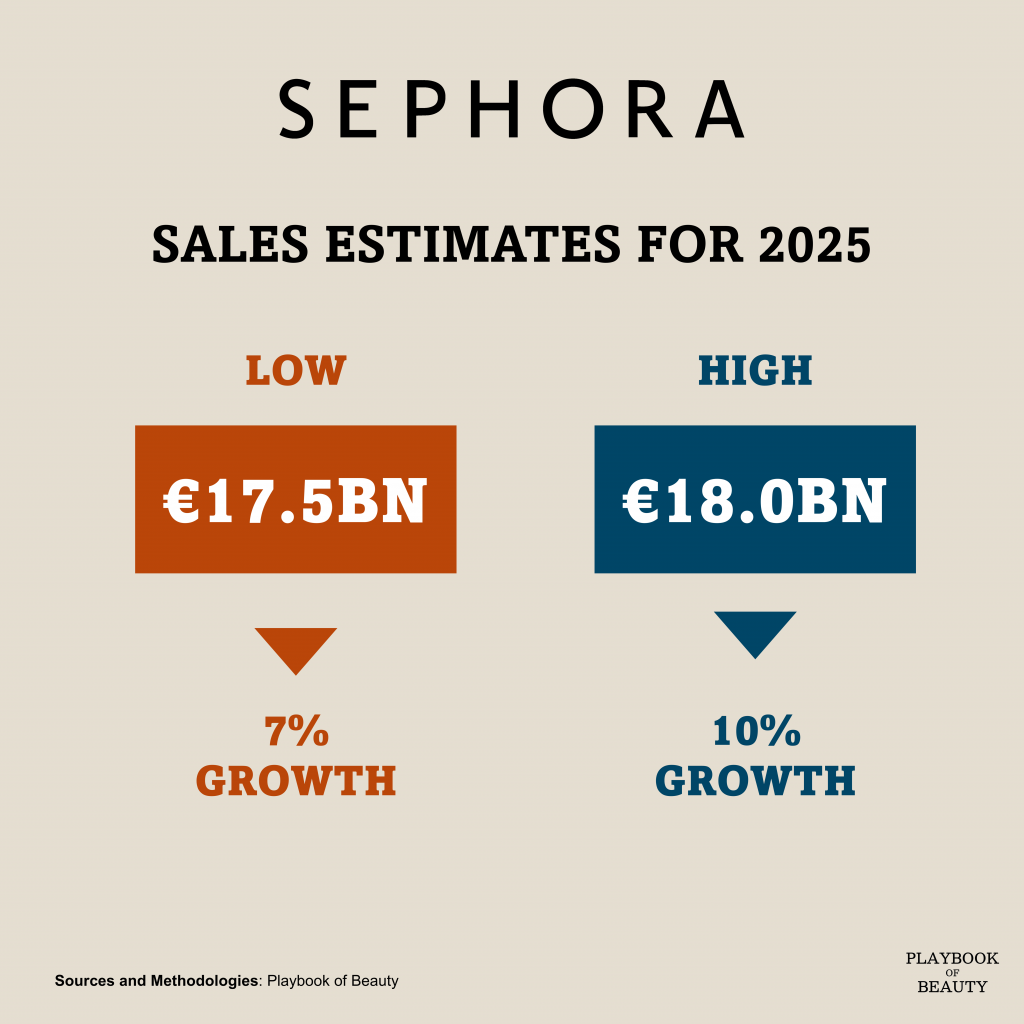
Working through the arithmetic, I reckon Sephora most likely landed between €17.5bn and €18.0bn in 2025, implying reported growth of 7% to 10%. The midpoint sits around €17.7bn, or roughly 8% reported growth. This is a deceleration from 2024 but still places Sephora as the single largest growth contributor across the entire LVMH group this year and the second largest brand within the group after Louis Vuitton which says something about where beauty sits in the current luxury cycle.