Data from Perfumist, an app that maps perfume preferences worldwide, reveals a divided fragrance landscape across Latin America in 2025.
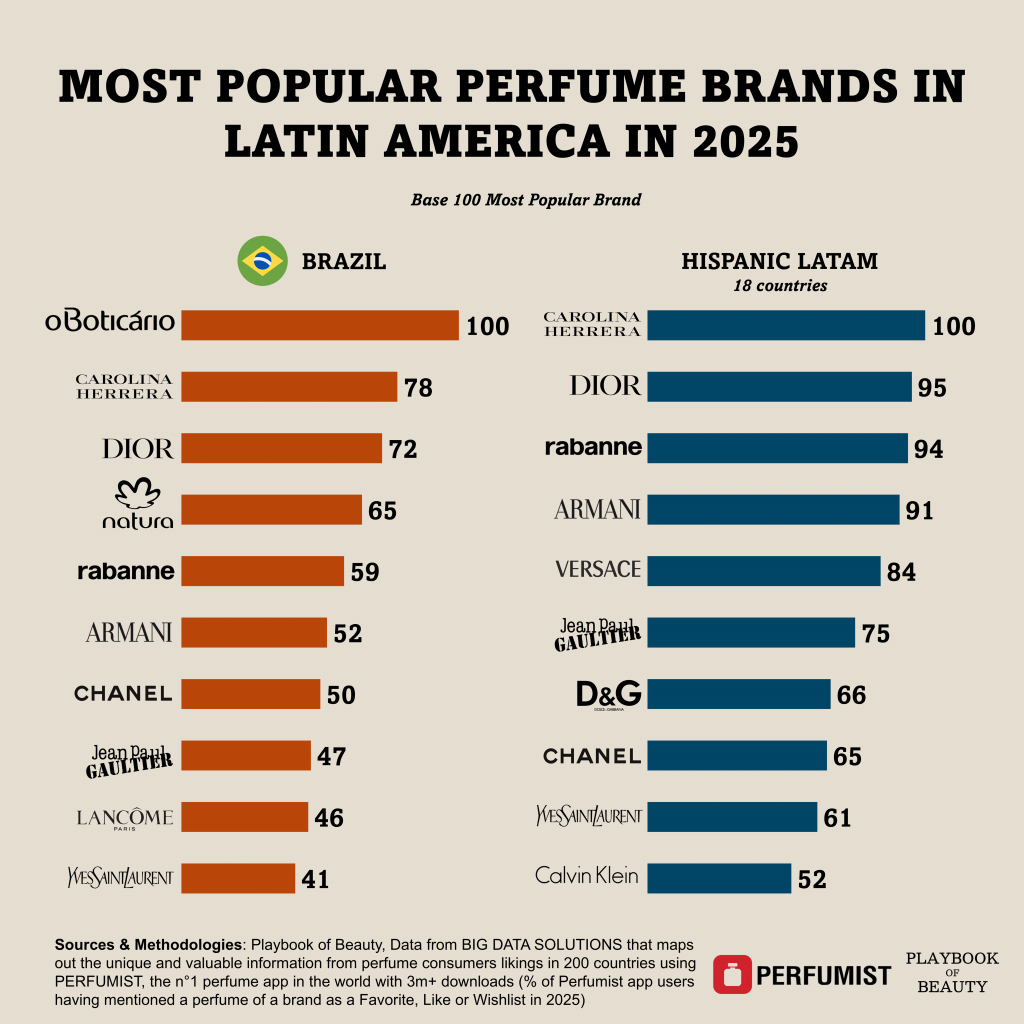
In Hispanic countries (Mexico, Colombia, Argentina, and 15 others) Carolina Herrera takes the top spot, followed by Dior and Rabanne. Brazil, the world’s second-largest perfume market after the US according to Euromonitor, shows a similar hierarchy for international brands. Puig emerges as the best-positioned group in the region, placing three brands inside the top ten, two of which sit in Hispanic Latam’s top three.
But Brazil’s overall preference tells a different story with local players actually dominating the ranking. O Boticário ranks as Brazil’s favourite perfume brand by a wide margin, while Natura holds fourth place. When shifting from brands to individual fragrances, a paradox emerges. Despite local brands dominating the top spots, every perfume among Brazil’s ten most-loved is global. La Vie Est Belle EdP leads, followed by Good Girl EdP and Sauvage EdT. That last fragrance also ranks first across Hispanic Latin America. This shows that despite Brazil being a seemingly attractive market for international perfume brands, only the top brands can perform locally, due notably to the very high tariffs on beauty products (~60%).
Scent preferences further divide Brazil and the rest of the continent. Brazilians lean towards floral (63.2% of consumers), with oriental a distant second (52.1%). In Hispanic countries, woody takes the lead (54.2%), followed closely by floral (53.8%).