A new YouGov survey conducted between December 2025 and January 2026, polling citizens in 18 countries, reveals a real dichotomy in how the world approaches skin aging. While nearly half of the global population (48%) considers fighting the signs of aging important, only a fraction, at just 11%, actually take active steps to do so.
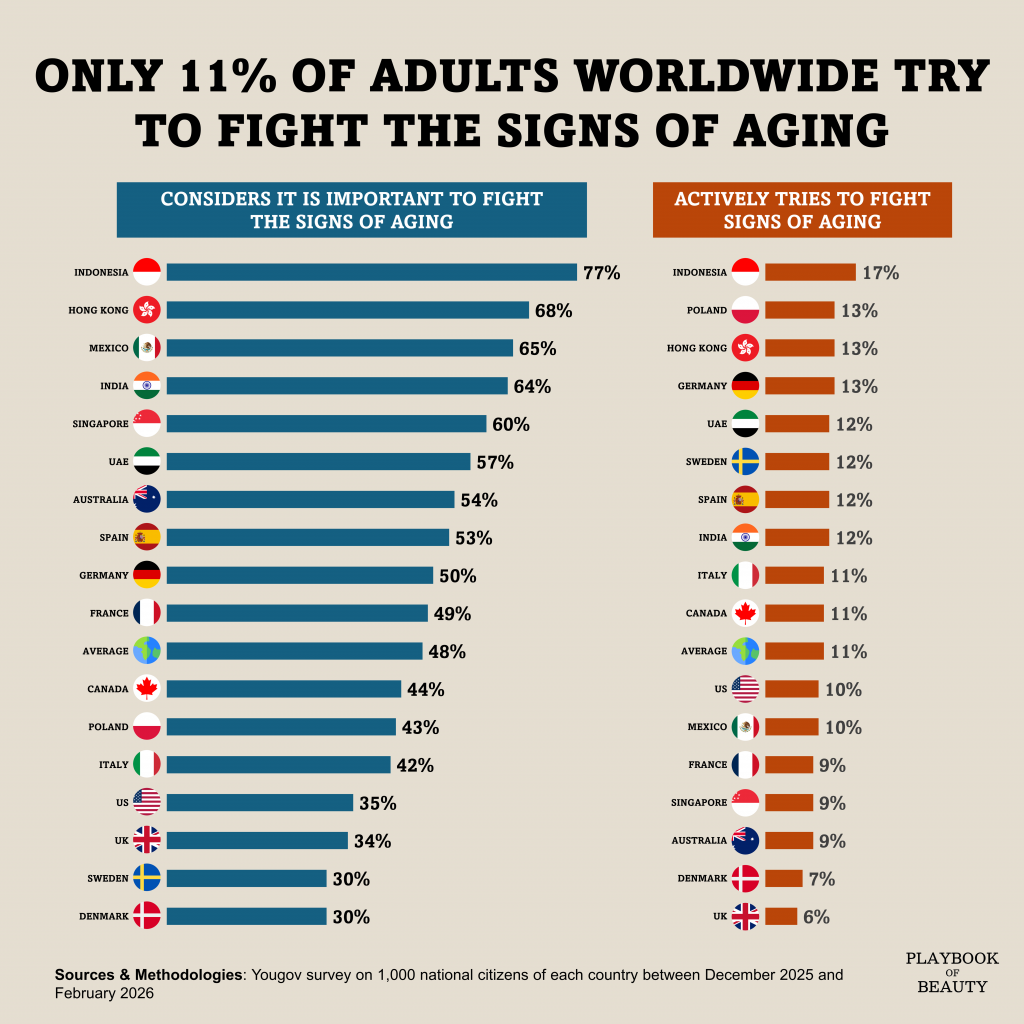
There is clear geographic split in mindset. In Indonesia, 77% of respondents view anti-aging as a priority, followed closely by Hong Kong (68%) and Mexico (65%). Across Asia and Latin America, the consensus is that intervention matters. At the other end of the spectrum, Northern Europe and Italy sit alongside North America at the bottom of the ranking. Less than half of citizens in the US (35%), the UK (34%), Sweden (30%), and Denmark (30%) see anti-aging as a priority. Germany, France, and Spain occupy a middle ground slightly above the global average of 48%.
Yet when we shift the focus to action, the ranking reshuffles. Indonesia retains the top spot, with 17% actively fighting signs of aging. But Poland and Sweden, which ranked near the bottom in perceived importance, jump significantly when looking at actual behavior. Conversely, Mexico and Singapore, despite high levels of stated concern, are in the lower end of the action ranking.
Cultural attitudes toward aging are not always a reliable predictor of consumer behavior. The gap between what people say they value and what they actually do is likely mediated by economic conditions, education, and access. A society may prize youthfulness in the abstract, but real-world action remains a function of disposable income, market penetration of products, and individual motivation. But in the end the result is a global market where awareness is high, but conversion still remains low.