The assumption that a unified marketing strategy can capture the beauty consumer is now untenable as shown by recent data from Provoke Insights on the top discovery channels for beauty brands of American consumers.
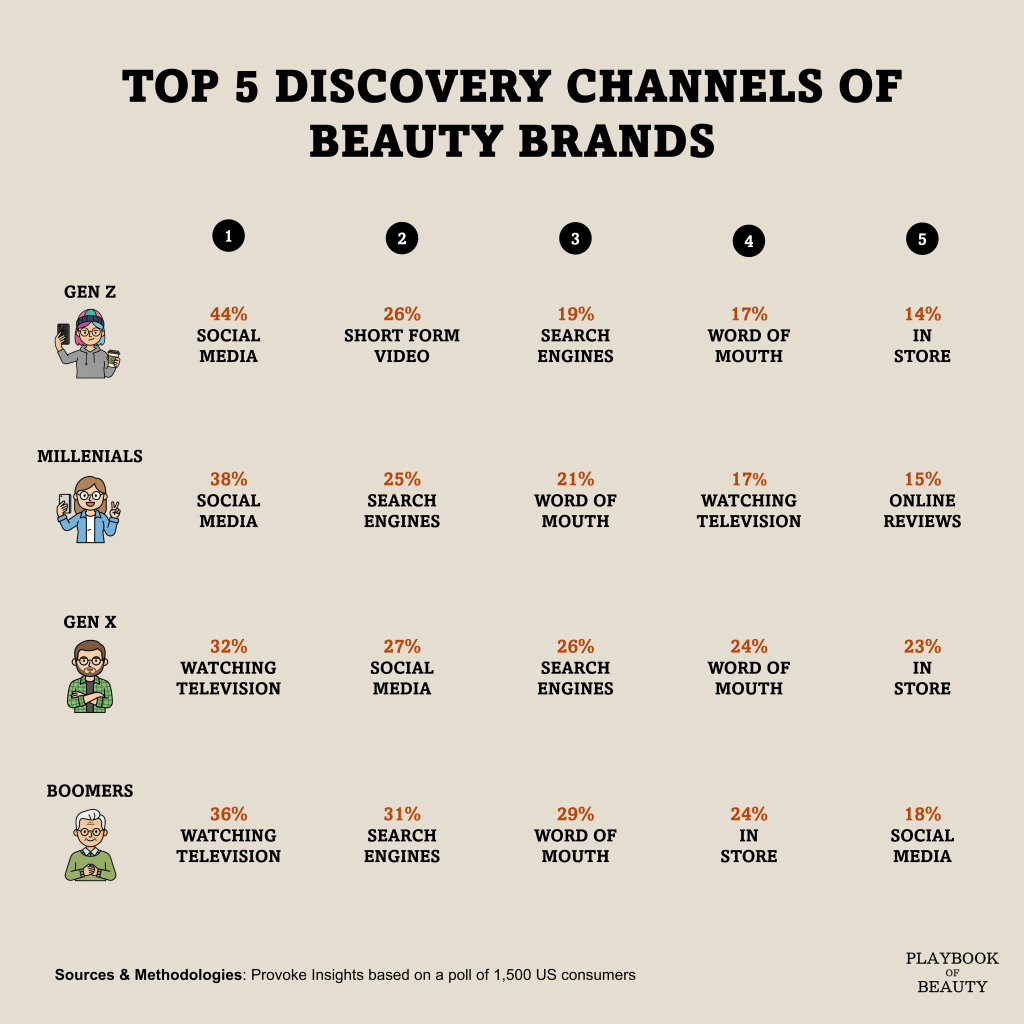
For young consumers, the traditional broadcast model has been replaced by the feed. Social media is the primary discovery engine for both Gen Z (44%) and Millennials (38%). Conversely, for Gen X and Boomers, television still ranks as the number one channel for both demographics (32% and 36%, respectively). As such a brand launching a clinical serum for aging skin would find significant ROI in traditional TV while a trendy color cosmetic line would see that same spend largely evaporate.
This divergence extends to how consumers validate their choices. The act of “search” now has two distinct meanings. Boomers (31%) and Gen X (26%) still rely heavily on traditional search engines, often typing in a brand name they just saw on a commercial. Gen Z, however, views search differently. Only 19% cite traditional search as a key channel. For them, discovery happens within the platforms themselves. They query TikTok and Instagram for routines, making investment in social SEO (optimizing captions and Reels for platform-native search) just as critical as Google AdWords for this cohort.
While social media is a broad category, Gen Z massively over-indexes on short-form video (26%, compared to just 1% for Boomers) and influencer content (12%). This generation, defined by the “skintellectual” movement and a preference for dermatologist-backed products, requires bite-sized, educational content from credible micro-influencers and estheticians.
Yet, the digital realm does not own every demographic. For Gen X and Boomers, the physical world remains highly influential. In-store discovery accounts for nearly a quarter of their decision-making (23% and 24% respectively), and word of mouth is similarly robust (24% and 29%). For brands targeting older, affluent consumers shopping at retailers like Bluemercury, the in-store beauty advisor remains a critical asset. Packaging, shelf placement, and the ability to generate organic conversation physically are a must.
Millennials occupy the complex middle ground. While they are digitally native, relying heavily on social (38%) and search (25%), they are also the generation most defined by skepticism and research. They index highest for online reviews (15%). They discover a brand on Instagram, cross-reference its ingredients on Google, and meticulously go through ratings at Sephora or Ulta before committing. For this group, social proof and transparent ingredient lists are not just nice-to-haves they are prerequisites for conversion.
This shows that the modern beauty brand must operate less like a monolith and have different micro-strategies, calibrated precisely to the media habits and validation rituals of each generation.