South Korea became the world’s second-largest beauty exporter in 2025, surpassing the United States with €10bn in exports and behind France with €23.3 billion. Korea also overtook France as the top exporter of beauty products specifically to the US in 2024, its first time outpacing France in that market.
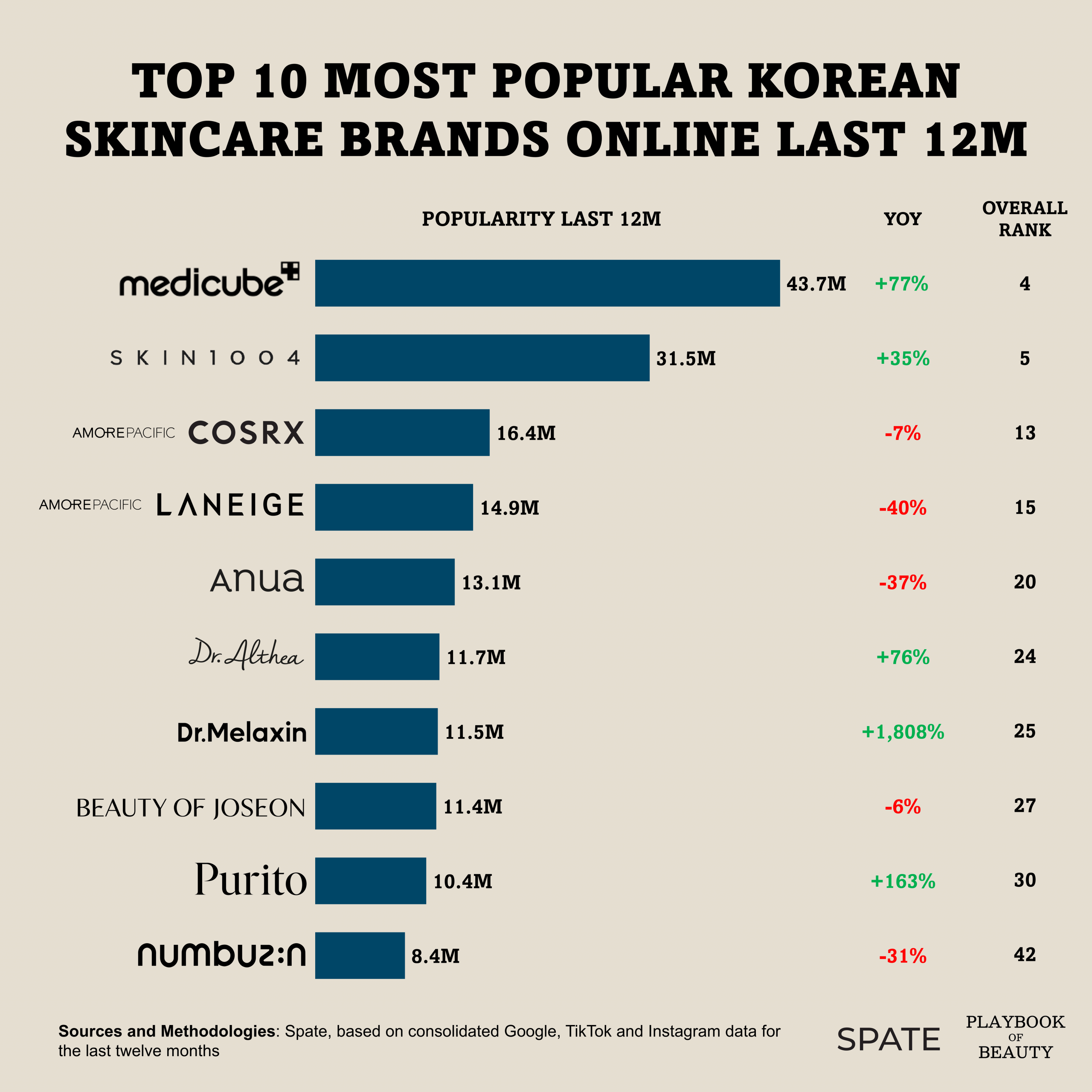
According to Spate, the leading AI-powered consumer trend intelligence platform, Korean brands also dominate the online skincare conversation. The attached infographic, based on consolidated Google, TikTok and Instagram data from Spate for the last twelve months, shows two Korean brands in the global top 10 most popular skincare brands online and seven in the top 25 just behind the US with eight, and ahead of France with six.
COSRX (ranked 13th globally) and Laneige (ranked 15th globally) both belong to Amorepacific, Korea’s largest beauty group. The other eight on this list are independent. And they are young. Excluding Laneige, founded in 1994, the average founding year for the brands on this ranking is 2017. Less than ten years old, and already competing at scale against legacy Western brands like La Roche-Posay or Neutrogena.
Where does the success of Korean brands come from? South Korea had more than 28,000 licensed cosmetics sellers in 2024, nearly double that of five years earlier, creating an environment forcing constant experimentation. Products are developed for a demanding domestic market producing formulas that are already proven before they reach international shelves. The manufacturing speed, combined with a social media strategy built around visual proof (before-and-afters, texture demonstrations, real skin reactions) does the rest.
Dr. Melaxin is a good example. Founded in 2021 by CEO Kyoung Hwa-yu the brand saw its social popularity rise 1,808% year-on-year to reach 11.5 million, landing it at rank 25 overall among skincare brands. The first viral moment happened in January 2025, when TikTok user @painfreebeauty demonstrated the Peel Shot’s exfoliating effect, generating over 500K+ views from a single video. The content showed blackheads and dead skin peeling away. Unglamorous, direct and impossible to fake. Dr. Melaxin then scaled that initial traction with a network of 16,600 creators, with 82% of its GMV on TikTok Shop coming from affiliates, supported by a commission rate of up to 30% according to data from Tramicheck. This shows the importance of distribution over discovery: virality opens the door, but volume comes from building an ecosystem of creators who keep the product in circulation.
The brands on this ranking are not better at social media but built around a product development process that assumes the consumer is also a reviewer, a distributor and a creator and price and formulate accordingly.